Market Instruments analyzes the design and operation of carbon pricing, cap-and-trade, and offsets for reducing greenhouse gas emissions. The research covers offsets program development, leakage risks, and the interaction of these instruments with power markets and social cost estimates.
Publications and Presentations
Found 7 of 7
- 2025 Article
- 2020 Article
Estimating Power Sector Leakage Risks and Provincial Impacts of Canadian Carbon Pricing
John Bistline, James Merrick, Victor Niemeyer Environmental and Resource Economics
- 2018 Article
Social Cost of Carbon Pricing of Power Sector CO2: Accounting for Leakage and Other Social Implications from Subnational Policies
John Bistline, Steven Rose Environmental Research Letters 13 014027.
- 2012 Report
- 2010 Report
- 2010 Report
EPRI Reports
Found 14 of 14
| Details | Title | Authors | Date | Type |
|---|---|---|---|---|
Use Cases of Energy Attribute Certificates | WHITE PAPER | |||
Over the past decade, energy attribute certificates (EACs) have evolved from their original purpose for utility compliance with Renewable Portfolio Standards (RPS) to broader applications. Today, EACs are used in a variety of voluntary and regulatory applications, including scope 2 market-based greenhouse gas (GHG) accounting, renewable electricity claims, clean fuel and hydrogen certification programs, and financial accounting. This white paper provides an overview of how EACs are used across these functions to track and verify electricity-related attributes, support emissions accounting and compliance objectives, and reduce the risk of double counting and over-allocation of environmental claims. | ||||
Measuring Impact and Taking Credit for Electric Company Actions that Reduce Greenhouse Gas Emissions | TECHNICAL UPDATE | |||
In recent years, many electric companies, combined electric and natural gas utilities, and other companies have adopted aggressive corporate decarbonization and “net-zero” goals. However, in the current fractured regulatory landscape of voluntary and regulatory carbon markets and the ongoing, rapid evolution of existing greenhouse gas (GHG) emissions accounting and disclosure rules, it is not clear how electric companies can report, track and “take credit” for actions they may take that reduce their GHG emissions. This EPRI report explores three interrelated research questions: (i) What types of actions can electric companies and combined electric and natural gas utilities take to reduce their scope 1, 2 and 3 greenhouse gas emissions? (ii) How can electric companies and combined utilities measure the impact of actions and activities they may take to reduce their greenhouse gas emissions? (iii) How can electric companies and combined utilities report and “take credit” for GHG emissions reductions they may have achieved? | ||||
Value of Voluntary Carbon Markets in Energy Systems Decarbonization: Regional Economic, Environmental, and Technological Impacts | TECHNICAL UPDATE | |||
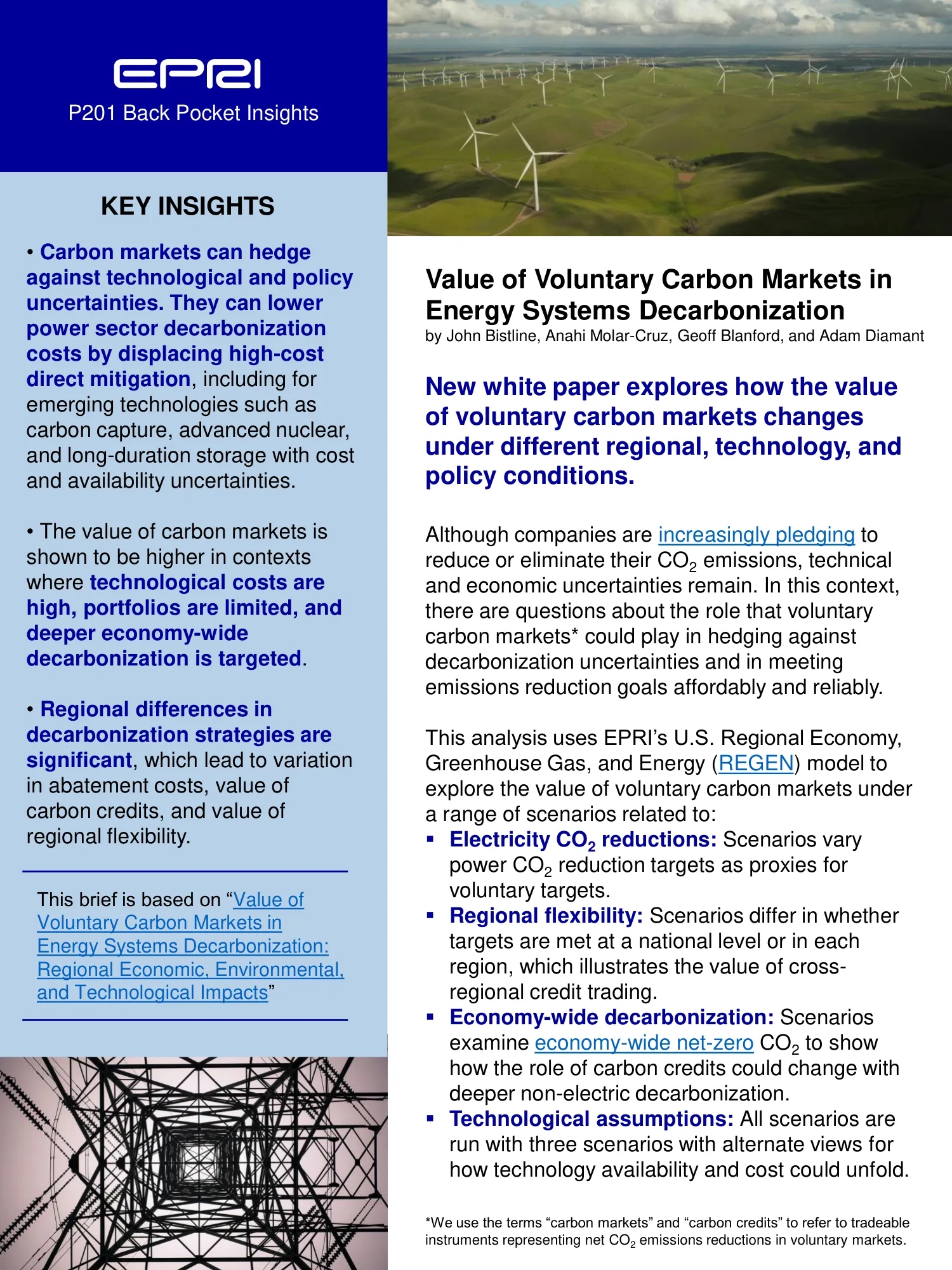
Although companies are increasingly pledging to reduce or eliminate their carbon emissions, technical and economic challenges remain, particularly for emissions tied to factors beyond a company’s control such as interconnection queues, permitting, inflation, growing load, and supply chain delays. Given these uncertainties, there are questions about the role that voluntary carbon markets could play in helping to meet electric sector decarbonization and corporate emissions reductions goals affordably and reliably. This analysis uses EPRI's U.S. Regional Economy, Greenhouse Gas, and Energy (REGEN) model—linking detailed electric sector capacity planning and fuels supply with representations of demand in buildings, transport, and industry—to explore how the value of voluntary carbon markets may change under different regional, technology, and policy conditions. Model results suggest that carbon markets can lower power sector decarbonization costs by displacing high-cost direct mitigation, including emerging technologies with uncertainty about their cost and availability such as carbon capture, advanced nuclear, long-duration energy storage, and hydrogen. In this context, voluntary carbon markets could function as hedges against technological uncertainty, especially in the deployment of nascent technologies. The value of carbon markets is shown to be higher in contexts where technological costs are high, portfolios are limited, and deeper economy-wide decarbonization is targeted. Results also illustrate how regional differences in decarbonization strategies are significant, which lead to variation in abatement costs, value of carbon credits, and value of regional flexibility. Overall, these scenarios indicate that net-zero targets with flexibility about the use of sectoral, regional, and technological emissions reductions can help to minimize costs while increasing the likelihood that targets are achieved. | ||||
Exploring the Role of Greenhouse Gas Emissions Offsets to Achieve Corporate Decarbonization Goals: A Compendium of Technical Briefing Papers and Frequently Asked Questions | TECHNICAL UPDATE | |||
As electric companies and combined electric and natural gas utilities develop strategies and make plans to reduce their future greenhouse gas (GHG) emissions, some are considering the role that GHG emissions offsets may play in assisting them to meet their short, mid, and long-term decarbonization and “net zero” goals. In some cases, these companies may be considering developing GHG emissions offsets projects themselves, and/or buying approved GHG emissions offset credits generated by third-party developers. Incorporating GHG emission offsets into a company’s decarbonization strategy is a complex undertaking, requiring a breadth of knowledge about GHG emission offset project development, market structures, and the various ways in which offsets can be used to complement broader decarbonization goals. This report is a compendium of briefing papers and Frequently Asked Questions (FAQ) developed to support a series of webcasts EPRI hosted in 2022 as part of an EPRI supplemental project on Exploring the Role of Greenhouse Gas Emissions Offsets to Achieve Corporate Decarbonization Goals. This technical transfer project was designed to improve participants’ understanding of the technical aspects of GHG emissions offsets, including key characteristics of offsets and existing and evolving offsets crediting programs and markets and explore strategies to communicate more clearly and effectively about companies’ use of GHG emissions offsets; and provide a technical forum, guided by EPRI experts, for participants to discuss opportunities and challenges related to using offsets in company decarbonization strategies. | ||||
Carbon Price Impacts on Electricity Prices | TECHNICAL UPDATE | |||
This research shows how a carbon price impacts electricity price formation by reconfiguring the economic trade-offs between technologies, and then demonstrates how relative fuel price impacts from a carbon policy can influence end-use capital investment decisions to incentivize (or disincentivize) electrification. The results show that a carbon price impacts electricity prices less, proportionally, than it impacts prices for natural gas and gasoline, implying that an economy-wide carbon price would act as an incentive for electrification, and an electric-sector only carbon price would act as a disincentive for electrification. These concepts are illustrated in a scenario analysis featuring a high-level representation of the Carbon Leadership Council’s “Baker-Schultz” carbon tax proposal of 2019, implemented in EPRI’s U.S. Regional Economy, Greenhouse Gas, and Energy (US-REGEN) Model. | ||||
Exploring the Interaction Between California’s Greenhouse Gas Emissions Cap-and-Trade Program and Complementary Emissions Reduction Policies | TECHNICAL UPDATE | |||
California enacted Assembly Bill 32 (AB 32) to address climate change in 2006. It required the California Air Resources Board (ARB) to develop a plan to reduce the State’s greenhouse gas (GHG) emissions to 1990 levels by 2020. ARB developed a plan (i.e., the “Scoping Plan”) made up of a GHG emissions cap-and-trade program and regulatory measures known as “complementary policies” (CPs) to achieve the 2020 target. The CPs, which were designed to achieve climate policy and other important policy objectives, targeted emissions from sectors covered by the GHG cap-and-trade program and those not covered by the program. ARB estimated that the CPs would achieve approximately 80% of the emissions reductions required to achieve the 2020 emissions target. Other jurisdictions, including the European Union, Australia, and the states that make up the Regional Greenhouse Gas Initiative, have developed a similar hybrid policy approach to achieve climate policy objectives. Although this approach has been widely used to address climate change, little analysis has been undertaken on the interactions between CPs and GHG cap-and-trade programs and their impacts on program costs and covered entities. The report concludes that the performance of CPs in achieving emission reductions will have a significant impact on the level of abatement that covered sources will need to achieve to meet the fixed emissions cap in the GHG cap-and-trade program and on expected GHG emission allowance prices. In addition, the potential variance in the performance of CPs and other variables, and recent regulatory decisions that have been made regarding program implementation, will complicate the efforts of electric companies to develop an effective risk management strategy to comply with the program. Conclusions regarding the directional impacts of varying levels of CP performance on emission reduction requirements and allowance prices in California’s cap-and-trade program likely will be applicable to other jurisdictions employing the same policy model to address climate change. | ||||
"Blue Sky" Approaches to Reduce Greenhouse Gas Emissions: An Initial Assessment of Potential New Types of Greenhouse Gas Emissions O ffsets | TECHNICAL UPDATE | |||
This report provides an initial assessment of potential new approaches to reducing greenhouse gas (GHG) emissions that might be capable of generating large-scale GHG emissions offsets at relatively low cost compared to other GHG mitigation options. The nine potential blue sky approaches assessed in this report include biochar, destruction of ozone depleting substances, control of natural fugitive methane seeps from coal seams, control of fugitive natural gas emissions associated with hydraulic fracturing and shale-gas extraction, "blue" carbon, enhanced soil carbon sequestration associated with dedicated energy crops, improved management of small ruminant animals, geo-mitigation opportunities such as control of volcanic emissions and avoiding permafrost melting, and geo-engineering techniques such as ocean carbon fertilization. These blue sky technologies might be able to reduce GHG emissions domestically and internationally; in some cases, they could potentially be used to create GHG emissions offsets. These offsets could potentially be used by electric power companies and others to comply with existing and evolving GHG emission reduction programs, such as cap-and-trade programs. Our initial assessment of these approaches indicates that biochar, ozone depleting substance destruction, blue carbon, and ocean iron fertilization have the greatest potential to achieve large-scale, low-cost (GHG) mitigation. Biochar and blue carbon appear to have significant potential to qualify as new offsets types that could potentially benefit from further research by the Electric Power Research Institute (EPRI). Ozone depleting substance offsets are already in the marketplace and, therefore, are not likely to benefit significantly from additional research. Ocean iron fertilization must achieve greater levels of scientific and public acceptance before this category can become a potential source of GHG offsets. | ||||
Designing a Large-Scale Federal Greenhouse Gas Offsets Program in the United States: Policy Choices and Lessons Learned from the Cle an Development Mechanism and Other Offsets Programs | TECHNICAL UPDATE | |||
If the United States decides to take broader action in the future to mitigate climate change, policy discussions may once again focus on development of a greenhouse gas (GHG) cap-and-trade program combined with development of a large-scale GHG emissions offsets program. The compliance flexibility offered by these programs, and the economic incentives they create to identify and implement low-cost compliance options, have the potential to reduce significantly the costs to achieve significant emissions limitations. Realizing this potential, however, is not guaranteed. The overall design and key elements of an offset program will have a significant impact on whether a future offsets program can achieve the objective of stimulating investment in activities that create low-cost GHG reductions. Fortunately, the design of a U.S. program can benefit from experience to date with existing offset programs. In particular, U.S. policymakers can draw lessons from the experience of the first large-scale offset program in the world—the Kyoto Protocol's Clean Development Mechanism (CDM). By the end of 2012, the CDM is expected to issue offset credits for approximately one billion tons of CO2-equivalent (CO2e) emission reductions. This paper evaluates the CDM and other key existing offset programs, and draws lessons from these programs that can help to inform development of a potential future U.S. national or regional offsets program. | ||||
Aggregation of Greenhouse Gas Emissions Offsets: Benefits, Existing Methods, and Key Challenges | TECHNICAL UPDATE | |||
This report is designed to develop and disseminate to members of the Electric Power Research Institute (EPRI), the public at large, and participants in the world's evolving carbon markets a set of lessons learned about the aggregation of individual greenhouse gas (GHG) emissions offset projects into larger, organized configurations that can yield large-scale GHG emissions offsets. Aggregation puts together geographically and/or temporally dispersed activities that reduce emissions in a similar manner to streamline the process of qualifying and quantifying emissions offsets. This report examines approaches used by existing and evolving offset programs to facilitate offset project aggregation. It focuses on major existing offsets standards and aggregation approaches, including the United Nations' Clean Development Mechanism's Programme of Activities, the Verified Carbon Standard's grouped projects, the Climate Action Reserve's forestry protocol aggregation guidelines, the American Carbon Registry's aggregation guidelines for forestry projects, the Chicago Climate Exchange's soil conservation protocol, and the Alberta Offset System's tillage systems protocol. In addition, the report examines business models that offset project developers have employed to replicate one project type in order to streamline the process of generating offsets without the need to rely on a specific methodology for aggregation. The report also discusses options for sectoral crediting, an approach that seeks to reward specific economic sectors in specific regions if they exceed sectoral GHG emissions targets. Finally, key lessons learned are summarized, including:
| ||||
Emissions Offsets: The Key Role of Greenhouse Gas Emissions Offsets in a U.S. Greenhouse Gas Cap-and-Trade Program | TECHNICAL UPDATE | |||
For U.S. industries with operations that emit greenhouse gases (GHGs), climate policy is no longer a distant possibility — it is being planned and, in some cases, implemented today. While debate on a federal GHG trade program continues in Congress, CO2 emission reduction requirements have been put in effect in Northeastern States (i.e., the Regional Greenhouse Gas Initiative — RGGI), are being developed in California (to implement the state's "Global Warming Solutions Act" — AB32), and are being designed in the western states as part of the Western Climate Initiative — WCI). This issue paper considers the specific GHG emission reduction requirements that sectors covered under a U.S. cap-and-trade bill — including the electricity sector — may face, and the role that offsets could play in helping to meet these requirements cost-effectively. | ||||
1-10 of 14
Back Pocket Insights
Value of Voluntary Carbon Markets in Energy Systems Decarbonization
December 2024
The Role of GHG Emission Offsets in Achieving Corporate Decarbonization Objectives
December 2023
Greenhouse Gas Emissions Offsets: Programs, Protocols and Projects
November 2023
Technical Considerations and Requirements for Greenhouse Gas Emissions Offsets
November 2023
How does a carbon price impact electricity prices?
January 2021