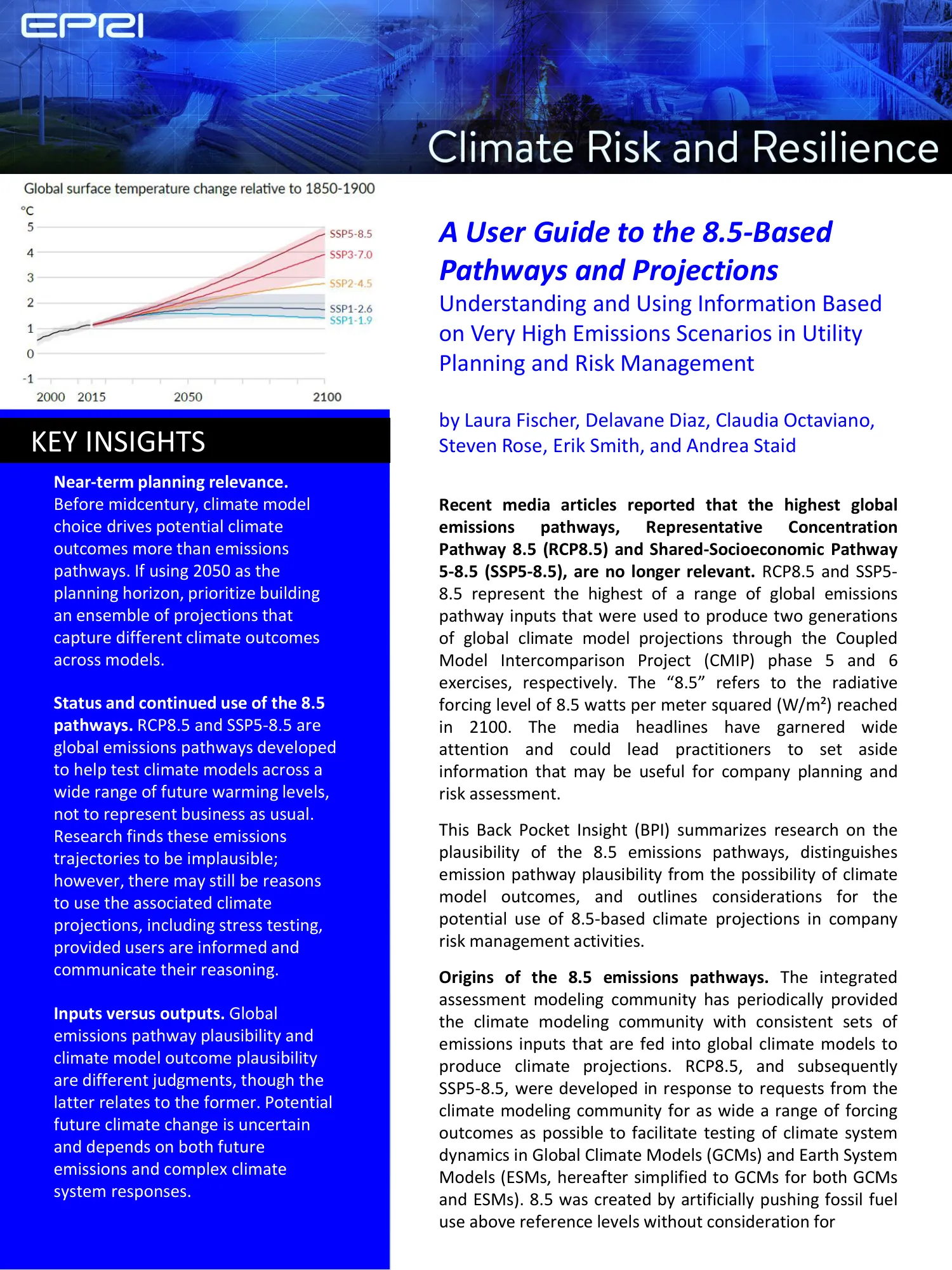
Climate Data and Physical Risk Assessment evaluates climate datasets and downscaling methods and produces the climate data products used in power system analysis. The research projects how hazards such as extreme heat, extreme cold, hurricanes, tornadoes, and wildfires change in a warming climate and assesses the resulting physical risks to generation, transmission, and distribution assets. Planning guidance and tools help companies incorporate these risks into long-range decisions.
Publications and Presentations
Found 11 of 11
- 2026 Article
Characterising European Low Renewable Availability Events in Present and Future Climate Model Data.
Brayshaw, D. J., S. Poovadiyil, Laura Fischer, Daniel Kirk-Davidoff Meteorological Applications
- 2026 Article
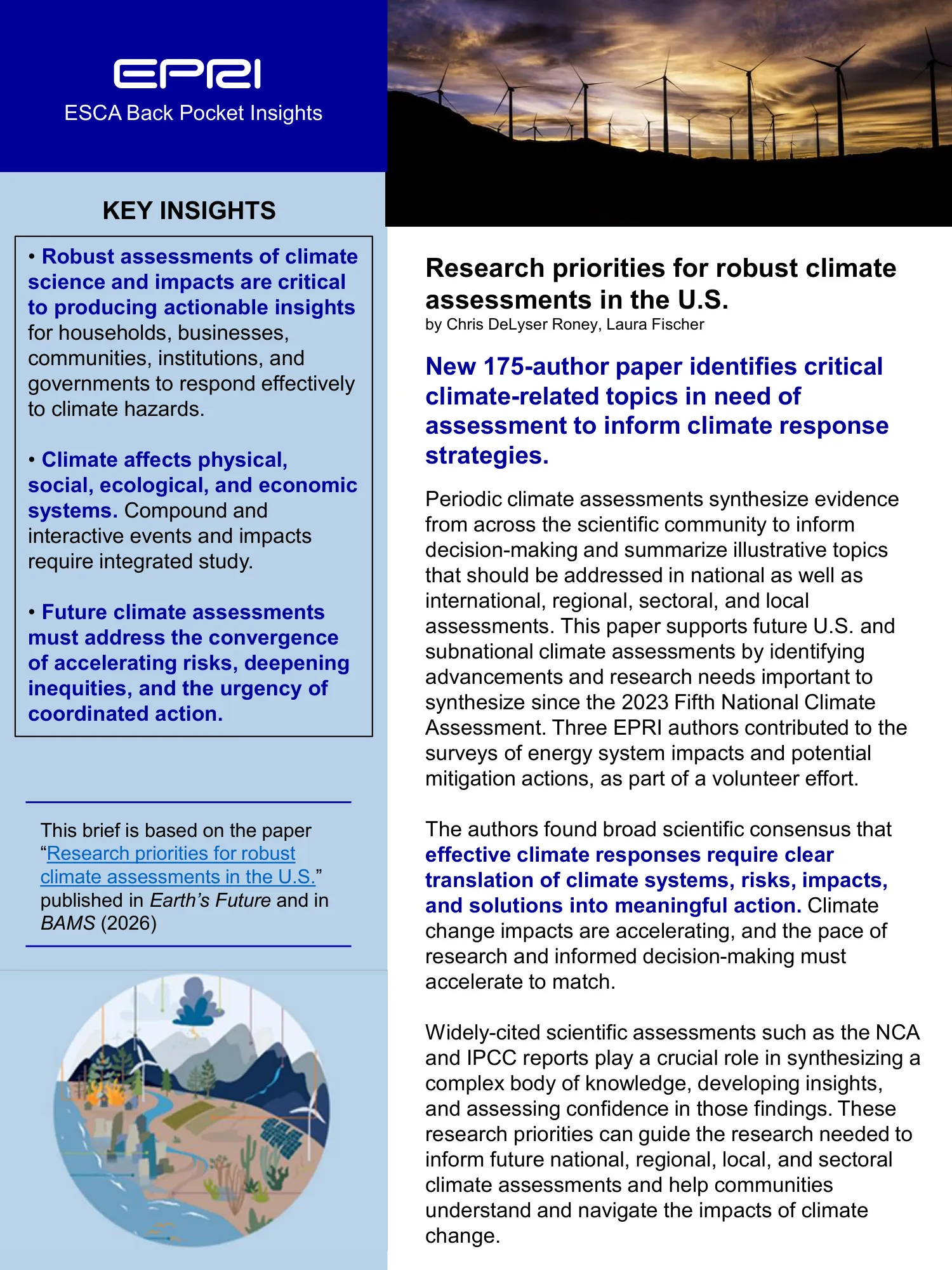
Research Priorities for Robust Climate Assessments in the United States
Kenney, Melissa A. et al (including Laura Fischer, Chris DeLyser Roney) Earth's Future
- 2025 Article
- 2025 Article
Evaluating the ability of gridded climate datasets to capture temperature and precipitation trends and extremes
Smith, N. Grant, X. Luo, Delavane Diaz Scientific Reports 15, 12607.
- 2025 Article
Evaluation of a High-Resolution Regional Climate Simulation for Surface and Hub-height Wind Climatology over North America
Peco et al. (including Caroline Draxl) Wind Energy Science.
- 2025 Article
Performance of wind assessment datasets in United States coastal areas
Sheridan, L. M. et al. (including Caroline Draxl) Wind Energ. Sci., 10, 1551–1574, https://doi.org/10.5194/wes-10-1551-2025, 2025.
- 2025 Article
Projected increases in tropical cyclone-induced US electric power outage risk
Rice, Julian R., Karthik Balaguru, Andrea Staid, Wenwei Xu, David Judi Environmental Research Letters 20, no. 3 (2025): 034030.
- 2025 Article
The Scenario Model Intercomparison Project for CMIP7 (ScenarioMIP-CMIP7)
Van Vuuren et al. (including Steven Rose) EGUsphere. Preprint available online and open for discussion.
- 2025 Article
Unit Commitment With Risk-Adjusted Tranching of Renewable Energy Resources
D. Osipov et al. (including Daniel Kirk-Davidoff) IEEE Transactions on Energy Markets, Policy and Regulation.
- 2025 Article
Using neural network models and synoptic circulation patterns to project future changes in US tornado activity
Lee, Cameron C., Omon A. Obarein, Erik Smith Journal of Geophysical Research: Machine Learning and Computation 2, no. 3 (2025): e2025JH000629.
- 2024 Article
Scenarios in IPCC assessments: lessons from AR6 and opportunities for AR7
Pirani, A., Fuglestvedt, J.S., Byers, E. et al. (including Steven Rose) npj Clim. Action 3, 1 (2024).
EPRI Reports
Found 36 of 36
| Details | Title | Authors | Date | Type |
|---|---|---|---|---|
Technical Considerations for Global Warming Level Frameworks for Climate Assessment and Use in Energy System Planning | TECHNICAL BRIEF | |||
This technical brief evaluates Global Warming Level (GWL) frameworks as an alternative to traditional scenario-year approaches for assessing climate hazards and informing energy system planning. Conventional climate assessments rely on projections tied to specific emissions pathways and future time horizons. This approach conflates uncertainties related to socioeconomic assumptions with those of climate model responses. In contrast, the GWL framework conditions climate outcomes on predefined global average temperature thresholds, effectively isolating the physical magnitude of global warming from model-driven regional variability. By enabling comparisons across multiple models and emissions pathways at consistent warming levels, GWL-based analysis can provide a clearer interpretation of climate signals. However, each framework represents uncertainty differently: scenario-year approaches emphasize temporal evolution and pathway dependence, while GWL approaches focus on physical climate states independent of timing. For utility planning, spanning infrastructure design, risk assessment, and regulatory compliance, these two frameworks are ultimately complementary. Rather than choosing one over the other, energy sector decision-makers can utilize hybrid approaches that integrate the temporal strengths of scenario-year modeling with the physical risk thresholds of the GWL framework. Finally, the brief identifies how emerging advances in climate modeling and artificial intelligence could further enhance these integrated assessments. | ||||
Evaluation of Sunairio High-Resolution Earth Data (SHED) and Sunairio ONE Climate Forecast Ensemble | TECHNICAL BRIEF | |||
This technical brief evaluates Sunairio’s High-Resolution Earth Data (SHED) and Sunairio ONE climate forecast ensemble for energy sector applications, including grid planning and resource adequacy modeling. Accurate analysis requires weather datasets with high spatial and temporal resolution, long duration, physical consistency, and the ability to capture evolving climate trends—requirements not fully met by existing public datasets. The study compares Sunairio datasets with observations and public sources such as ERA5, WTK, and NSRDB across more than 50 U.S. locations. Results show SHED generally performs comparably or better across key metrics, particularly for correlation and daily variability of wind speeds and solar irradiance. Sunairio ONE demonstrates strong physical realism in modeling future climate conditions but shows some limitations in capturing multi-day variability and extreme events. Overall, Sunairio provides a unified, high-resolution approach that can enhance energy planning, though further validation is recommended. | ||||
Story Map: Recent Climate Vulnerability Assessment Findings at Nuclear Plants | TECHNICAL REPORT | |||
This interactive storyboard summarizes findings from recent Climate Vulnerability Assessments (CVAs) conducted at nuclear power plants under EPRI and INPO guidance. CVAs are systematic, forward-looking evaluations of how projected climate hazards — including extreme heat, drought, intense storms, and biological fouling — may affect plant structures, systems, and components (SSCs) and their ability to operate reliably. The storyboard walks through the CVA process in four phases: recognizing climate risks and assembling cross-functional teams; screening and characterizing site-specific climate hazards; evaluating plant-level exposure and vulnerability through engineering analysis and walkdowns; and prioritizing response actions using an eliminate–mitigate–accept framework. Key findings indicate that rising air and cooling water temperatures represent the dominant hazard across all sites assessed, that the majority of SSCs retain adequate design margin under current conditions while a small number of cooling and heat-rejection systems show narrowing margins under mid-century projections, and that indirect and cascading exposure pathways — rather than direct thermal stress on individual components — often drive the most consequential vulnerabilities. Lessons learned emphasize the value of cross-functional engagement, system-level exposure assessment, structured walkdowns, coordinated multi-site campaigns that share insights in real time, and early initiation of design-basis data requests. Access the Story Map here: Climate Vulnerability Assessment | ||||
Story Map: Climate-Resilient Planning in the U.S. Midwest | TECHNICAL REPORT | |||
This illustrative case study applied portions of EPRI’s Climate Resilience and Adaptation initiative, or Climate READi™, framework to evaluate climate-related risks across the bulk and distribution grids for Wisconsin Power and Light Company (WPL) in the U.S. Midwest. It demonstrated how traditional planning processes can be leveraged to conduct climate-resilient planning by systematically integrating asset vulnerabilities, climate hazards, and societal considerations within a structured, coordinated approach. Results provide detailed key findings for the bulk and distribution systems by integrating asset vulnerabilities into modeling frameworks to quantify the impacts of extreme weather and climate hazards on reliability, which informed system adjustments. The findings also demonstrated cost-effective pathways to strengthening system resilience against climate-driven events by assessing the effects of increased severity while also considering the broader impacts on prudent investment decisions. Detailed sections include:
Click here to access the Story Map: Climate-Resilient Planning in the U.S. Midwest | ||||
Characterizing the Impacts of a Changing Climate on Tree-Related Outages and Utility Vegetation Management Effectiveness | TECHNICAL REPORT | |||
Electric utilities face challenges from tree related outages, which remain one of the most significant drivers of service interruptions across distribution systems. These outages already impose high reliability and resilience costs today, and the combination of aging infrastructure, evolving vegetation conditions, and intensifying climate stressors is expected to increase this risk in many regions. Vegetation management is one of the most resource intensive and operationally complex tools available for reducing outage risk, yet its effectiveness varies widely across geographies, forest types, weather regimes, and utility practices. Given the scale of investment required, utilities need a clear and evidence-based understanding of how vegetation management affects outage rates under current conditions, how these effects may change as the climate evolves, and how vegetation management compares to or interacts with other adaptation strategies. This report provides a foundation for understanding tree failures, their interactions with overhead distribution electric infrastructure, and the factors that influence how vegetation management can help reduce outages during storms, both today and in a changing climate moving forward. | ||||
READi Insights: Characterizing Discrepancies in Gridded Temperature Diurnal Cycles and Potential Consequences for Power System Planning | TECHNICAL BRIEF | |||
Gridded reanalysis products are widely used in energy system planning and operations to characterize long-term weather and extreme events. This study evaluates how three widely-used reanalysis products (ERA5, ERA5-Land, and MERRA2) capture the magnitude, timing, and shape of daily temperature cycles across the contiguous United States compared to in-situ station observations from 2000–2022. Results show that while bias correction can reduce some of the bias in gridded temperatures, discrepancies in the timing and shape of daily temperature extrema often remain. For example, ERA5, exhibits a 1–2 hour lag in the occurrence of daily extrema, most pronounced in winter and for western mountainous regions. While ERA5 generally shows the closest agreement with station observations in capturing the shape of hourly temperature around extrema, ERA5-Land and MERRA2 match observations more closely at many locations. These timing and shape discrepancies have direct implications for load forecasting, peak demand estimation, and grid flexibility requirements. We recommend that energy system practitioners carefully validate reanalysis datasets using metrics specific to their applications and regions before integration into planning and operational models. | ||||
Extreme Temperatures and the Grid: Bridging the Gap Between Weather and System Impacts | TECHNICAL BRIEF | |||
Recent extreme temperature events have challenged the energy grid, prompting new regulatory standards for grid resilience. However, the complex, non-linear relationship between weather and grid performance is often obscured by critical data gaps, thus planning for higher-intensity events without addressing these shortcomings can create a false sense of security. This technical brief summarizes a survey of the EPRI Global Change, Climate Risk, and Target Setting research advisors, which identifies a pressing practitioner need for technical guidance. It further details current data limitations, discusses several key implications of recent North American Electric Reliability Corporation (NERC) standards, and proposes robust extreme temperature event definitions to strengthen system planning. | ||||
EPRI Comments on the U.S. Department of Energy Climate Working Group Report, "A Critical Review of Impacts of Greenhouse Gas Emissions on the U.S. Climate" | TECHNICAL BRIEF | |||
In response to the U.S. Department of Energy’s (DOE’s) draft report, A Critical Review of Impacts of Greenhouse Gas Emissions on the U.S. Climate, released in July 2025, EPRI submitted formal comments during the public review period. As an independent, non-profit research organization with a public-benefit mission, EPRI often develops objective, science-based comments grounded in its extensive R&D portfolio and its unique role as the electricity sector’s collaborative research organization. EPRI’s comments in this case focus on the implications of the DOE report for the power sector, particularly in the areas of reliability, resilience, and adaptation. Drawing on research from EPRI’s Climate REsilience and ADaptation initiative (READi), as well as longstanding work in low-carbon pathways, air quality, and the social cost of carbon, the comments emphasize the importance of high-quality data, robust scientific foundations, and transparent methodologies. The report examines the DOE’s treatment of extreme weather, emissions policy, and socioeconomic risks, and offers constructive recommendations to improve the scientific rigor and practical relevance of the final report. EPRI’s contributions aim to support informed decision-making and continued public and scientific engagement on climate resilience and energy system planning. | ||||
An Approach for Characterizing Third-Party Physical Climate Risk Assessment Frameworks for Utility Applications | TECHNICAL UPDATE | |||
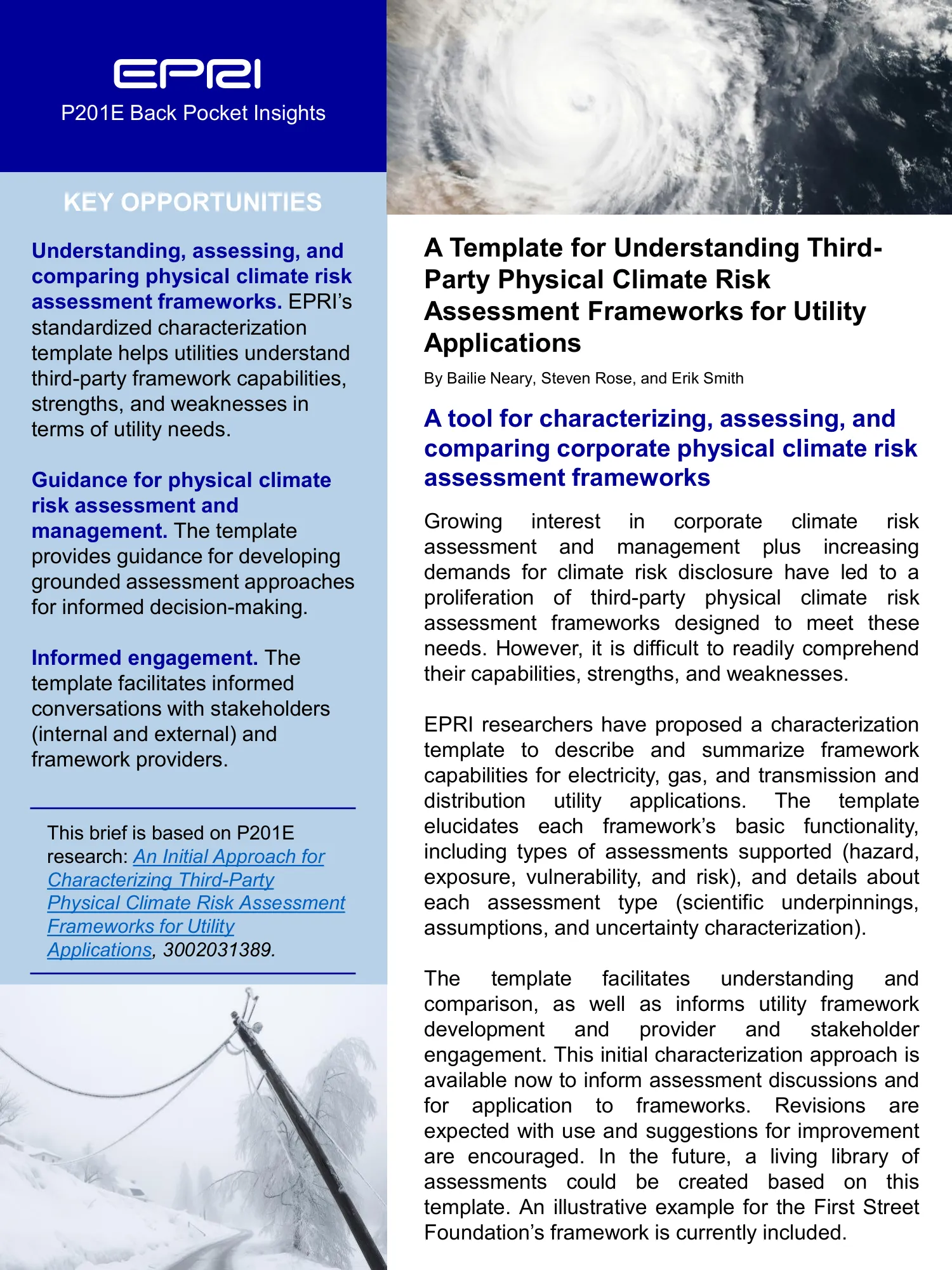
The increase in climate risk disclosure requirements has led to a proliferation of third-party physical climate risk assessment frameworks. It is difficult, however, to readily comprehend their strengths and weaknesses. As a result, utilities have expressed a desire to better understand the capabilities and differences between frameworks. Researchers in EPRI’s Global Change, Climate Risk and Target Setting research group (Project Set 201E) proposed an initial characterization template to describe and summarize framework capabilities for electricity, gas, and transmission and distribution utility applications. The characterization template is a spreadsheet with a series of questions that elucidates a framework’s basic functionality, including types of assessment supported, scientific underpinnings, assumptions, and uncertainty characterization. The goals of the characterization template are to provide utilities with a standardized approach to facilitate the following: (i) understanding and comparing framework capabilities; (ii) assessing framework capability for supporting utility applications; and (iii) informing utility framework conversations with providers and stakeholders. The accompanying characterization template spreadsheet also provides an example set of responses for the First Street Foundation’s framework, which includes their Flood Model, Fire Model, Wind Model and Correlated Risk Model. The initial characterization approach is offered for review and refinement with the goal of applying it to additional frameworks and developing a capability assessment library resource. | ||||
Selecting Climate Models and Metrics for Localized Climate Change Assessments | TECHNICAL BRIEF | |||
Companies are increasingly tasked with incorporating climate change information into planning and modeling. Availability of climate data is not the biggest challenge, as there is an abundance of public and proprietary climate data tools and portals, with more being added. However, understanding the information and how best to use and interpret it for local assessments is technically challenging, time consuming, and often expensive. For this reason, assessing local climate is not trivial, and creating actionable insights even more difficult. | ||||
1-10 of 36