
A core component of the Energy Systems and Climate Analysis group is the crosscutting nature of the group's work, which involves leadership contributions to EPRI Initiatives, as well as expert participation in forums outside of EPRI, and partnerships with leading climate and energy organizations around the world.
Across EPRI
DCFlex
Associated ESCA Staff: Nidhi Santen, Nils Johnson, Karen Tapia-Ahumada, Arin Kaye
The DCFlex initiative is a pioneering effort to demonstrate how data centers can play a vital role in supporting and stabilizing the electric grid while enhancing interconnection efficiency. It aims to drive a cultural, taxonomic, and operational transformation across the data center ecosystem, offering a comprehensive blueprint for stakeholders including utilities, market operators, technology innovators, and policymakers. Through four focused workstreams, DCFlex explores the technical, economic, and regulatory dimensions of data center flexibility.
Related Links:LCRI - Low Carbon Resources Initiative

Associated ESCA Staff: Geoff Blanford, Anahi Molar-Cruz, Nils Johnson, Todd Gorgian, Romey James, Chris DeLyser Roney, Anand Kumar, Steve Rose, Aranya Venkatesh
EPRI and GTI Energy are together addressing the need to accelerate development and demonstration of low- and zero-carbon energy technologies.
The Low-Carbon Resources Initiative (LCRI) will focus on large-scale deployment to 2030 and beyond. Fundamental advances in a variety of low-carbon electric generation technologies and low-carbon chemical energy carriers - such as clean hydrogen, bioenergy, and renewable natural gas - are needed to enable affordable pathways to economy-wide decarbonization.
This work will transition into Emerging Fuels and Technology beginning in 2027.
Related Links:Load Forecasting Initiative
Associated ESCA Staff: Delavane Diaz, Dan Kirk-Davidoff, Ryan Fulleman, Brandon Johnson
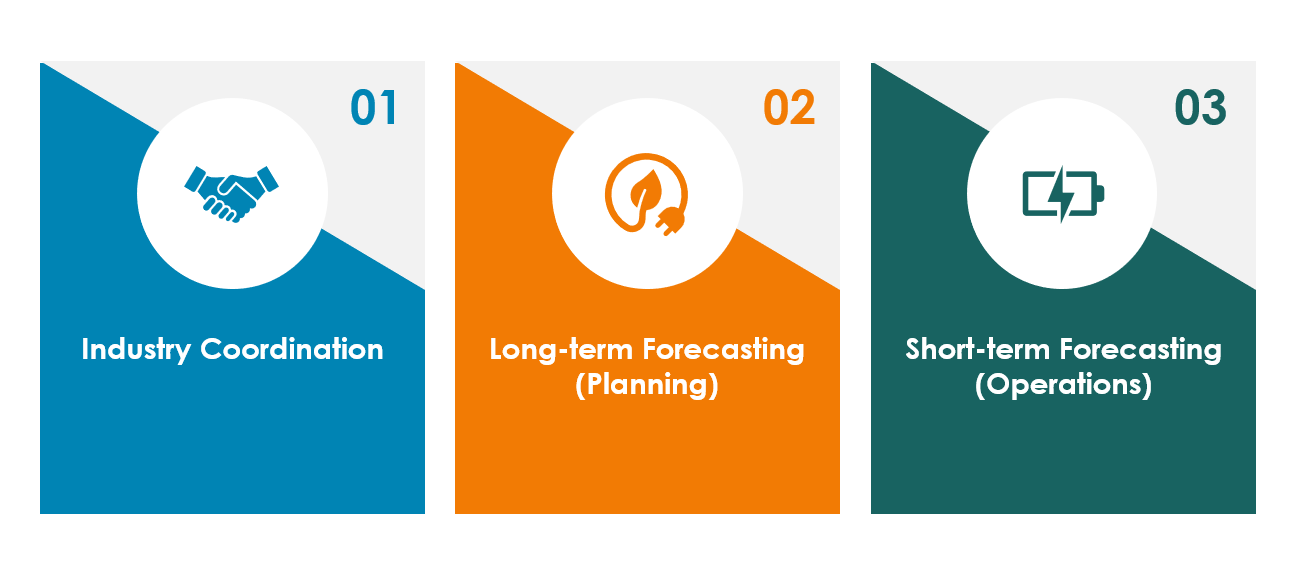
A new EPRI initiative to address increasing complexity in electric load forecasting, driven by electrification, decarbonization, extreme weather, and new industries. This initiative will improve load forecasting with research and development on synchronized renewable and load profiles, weather to load dynamics, probabilistic forecasting, distributed energy resource load characteristics, end-use technology adoption, future weather, new diagnostics and forecast benchmarking, and aligned distribution and transmission forecasts.
Related Links:Climate READi - Climate Resilience and Adaptation Initiative
Associated ESCA Staff: Laura Fischer, Andrea Staid, Delavane Diaz, Francisco Fonseca, Erik Smith, Daniel Kirk-Davidoff, Jonathan Lala, Nidhi Santen, Ryan Fulleman, Jacob Mardian
In response to the need to prepare the power system against the effects of climate change, EPRI completed the Climate Resilience and Adaptation Initiative (Climate READi). The initiative is built on the understanding that the resilience of the electric power system requires unprecedented collaboration. Climate READi will leverage decades of research by EPRI, U.S. National Research Laboratories, the DOE, academic institutions, and others to create a comprehensive, industry-accepted framework to guide electricity system adaptation and resilience decisions and investments.
EPRI continues this research in program P262: Climate Risk and Resilience.
Related Links:Integrated Strategic System Planning (ISSP)
Associated ESCA Staff: Nidhi Santen, Naga Srujana Goteti, Karen Tapia-Ahumada
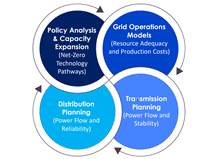
The ISSP initiative developed an analytical framework to assess future expansion plans across supply and delivery that incorporates distributed resources and ensures reliability. ISSP seeks to answer the following key strategic questions: what is the least-cost resource path to system-wide decarbonization? Is there sufficient capacity, energy, and flexibility to reliably balance supply and demand? What are the T&D investments for reliability and resiliency in a distributed, inverter-based supply mix? What T&D investments serve electrification and enable demand flexibility?
This work continues under P178: Resource Planning for Electric Power Systems and P40: Transmission Planning.
Related Links:Resource Adequacy Initiative
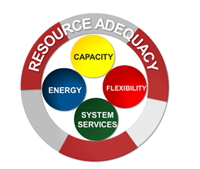
Associated ESCA Staff: Nidhi Santen, Naga Srujana Goteti, Daniel Kirk-Davidoff
A cross-cutting effort to integrate existing R&D to accelerate our ability to enable end-use demand flexibility for providing grid reliability and resiliency. The initiative focuses on technology development and customer adoption, modeling resource capabilities, and operation processes to deploy demand flexibility resources for providing grid services.
This work continues under P173: Bulk System Integration of Renewables and Distributed Energy Resources.
Related Links:Beyond EPRI
Intergovernmental Panel on Climate Change (IPCC)

Associated ESCA Staff: Aranya Venkatesh (AR6), Charles Hakkarinen (AR3, AR4)*, Claudia Octaviano (AR7), David McCollum (AR4, AR5, AR6, SR1.5)*, Delavane Diaz (AR6), Francisco de la Chesnaye (AR4)*, Geoffrey Blanford (AR5), John Bistline (AR6)*, Kristie Ebi (AR3, AR4, AR5, AR6, SR1.5)*, Louis Pitelka (AR2)*, Nils Johnson (AR5), Rich Richels (AR2, AR3, AR4, AR5)*, Steven Rose (AR4, AR5, AR6), Thomas Wilson (AR5)
The Intergovernmental Panel on Climate Change (IPCC) is the United Nations body for assessing the science related to climate change. The objective of the IPCC is to provide governments at all levels with scientific information that they can use to develop climate policies. IPCC reports are also a key input into international climate change negotiations. For the assessment reports, experts volunteer their time as IPCC authors to assess the thousands of scientific papers published each year to provide a comprehensive summary of what is known about the drivers of climate change, its impacts, and future risks, and how adaptation and mitigation can reduce those risks.
Related Links:National Climate Assessment (NCA)

Associated ESCA Staff: Chris DeLyser Roney, Laura Fischer, Delavane Diaz, John Bistline*
The National Climate Assessment (NCA) is coordinated by the U.S. Global Change Research Program, which was mandated by Congress in the Global Change Research Act of 1990 to prepare and submit to President and Congress an assessment of global change every 4 years. The NCA integrates, evaluates, and interprets the findings of the Program and discusses the scientific uncertainties associated with such findings; analyzes the effects of global change on the natural environment, agriculture, energy production and use, land and water resources, transportation, human health and welfare, human social systems, and biological diversity; analyzes current trends in global change, both human-induced and natural, and projects major trends for the subsequent 25 to 100 years.
Related Links:Energy Modeling Forum (EMF)

Associated ESCA Staff: Geoff Blanford, John Bistline*
The Stanford Energy Modeling Forum (EMF) seeks to improve the use of energy and environmental policy models for making important corporate and government decisions. Three major goals guide this effort: harness the collective capabilities of multiple models to improve the understanding of important energy and associated environmental problems, explain the strengths and limitations of competing approaches to the problem, and provide guidance for future research efforts.
Each EMF working group publishes a summary report that is widely distributed to policymakers, corporate leaders, and energy experts and advisors. A companion technical volume documents the analysis used to derive these conclusions.
EMF disseminates key findings broadly through reports, major conferences, Congressional testimony by participating experts, and participation by government staff in Forum activities. Companies help to frame the questions, but also learn which are the most important technical issues and which groups are pioneering new techniques for addressing them.
Related Links:Canadian Energy Modelling Hub

Associated ESCA Staff: Chris DeLyser Roney
The Energy Modelling Hub fosters ongoing dialogue among Canadian energy system modellers, policy makers, and stakeholders to drive Canada’s net-zero transition. It supports and elevates the work of the country’s energy-modelling ecosystem, bridging the gap between modelling expertise and clean energy policy insight. The EMH serves as a national forum, informing crucial policy decisions by exchanging research and practice of energy system modelling in Canada. It promotes the sharing of data and resources to advance the collective understanding of sustainable energy systems.
Related Links:* denotes former ESCA staff who collaborated during their EPRI tenure
Additional Collaborations
ESCA has contributed to collaborative projects with the following organizations:
- Argonne National Laboratory (ANL)
- Bipartisan Policy Center (BPC)
- California Energy Commission (CEC)
- Center for Resource Solutions (CRS)
- Clean Air Task Force (CATF)
- Department of Energy (DOE)
- Energy Information Administration (EIA)
- Environmental Defense Fund (EDF)
- Environmental Protection Agency (EPA)
- Idaho National Laboratory (INL)
- Integrated Assessment Modeling Consortium (IAMC)
- International Emissions Trading Association (IETA)
- International Energy Agency (IEA)
- International Energy Workshop (IEW)
- National Aeronautics and Space Administration (NASA)
- National Center for Atmospheric Research (NCAR)
- National Laboratory of the Rockies (NLR)
- Natural Resources Defense Council (NRDC)
- New York State Energy Research and Development Authority (NYSERDA)
- Nuclear Energy Agency (NEA)
- Pacific Northwest National Laboratory (PNNL)
- Resources for the Future (RFF)
- Sandia National Laboratories (SNL)
- The Brookings Institution