Equity and Distributional Impacts examines how the costs, benefits, emissions reductions, and health impacts of decarbonization policies are distributed across households, income classes, and communities. The work supports policy design that captures distributional effects in planning and operations and identifies opportunities for health- and equity-improving energy decisions.
Publications and Presentations
Found 5 of 5
- 2026 Article
Capturing the distribution of costs and benefits in electricity system planning and operations
Todd Levin et al. (including Chris DeLyser Roney, Heidi Scarth) Joule, Volume 10, Issue 4, 2026, 102387.
- 2024 Article
Equity implications of net-zero emissions: A multi-model analysis of energy expenditures across income classes under economy-wide deep decarbonization policies
John Bistline et al. Energy and Climate Change, 5, 100118.
- 2024 Article
Seizing the Policy Window for Health- and Equity-Improving Energy Decisions
Peng et al. (including John Bistline) One Earth.
- 2022 Article
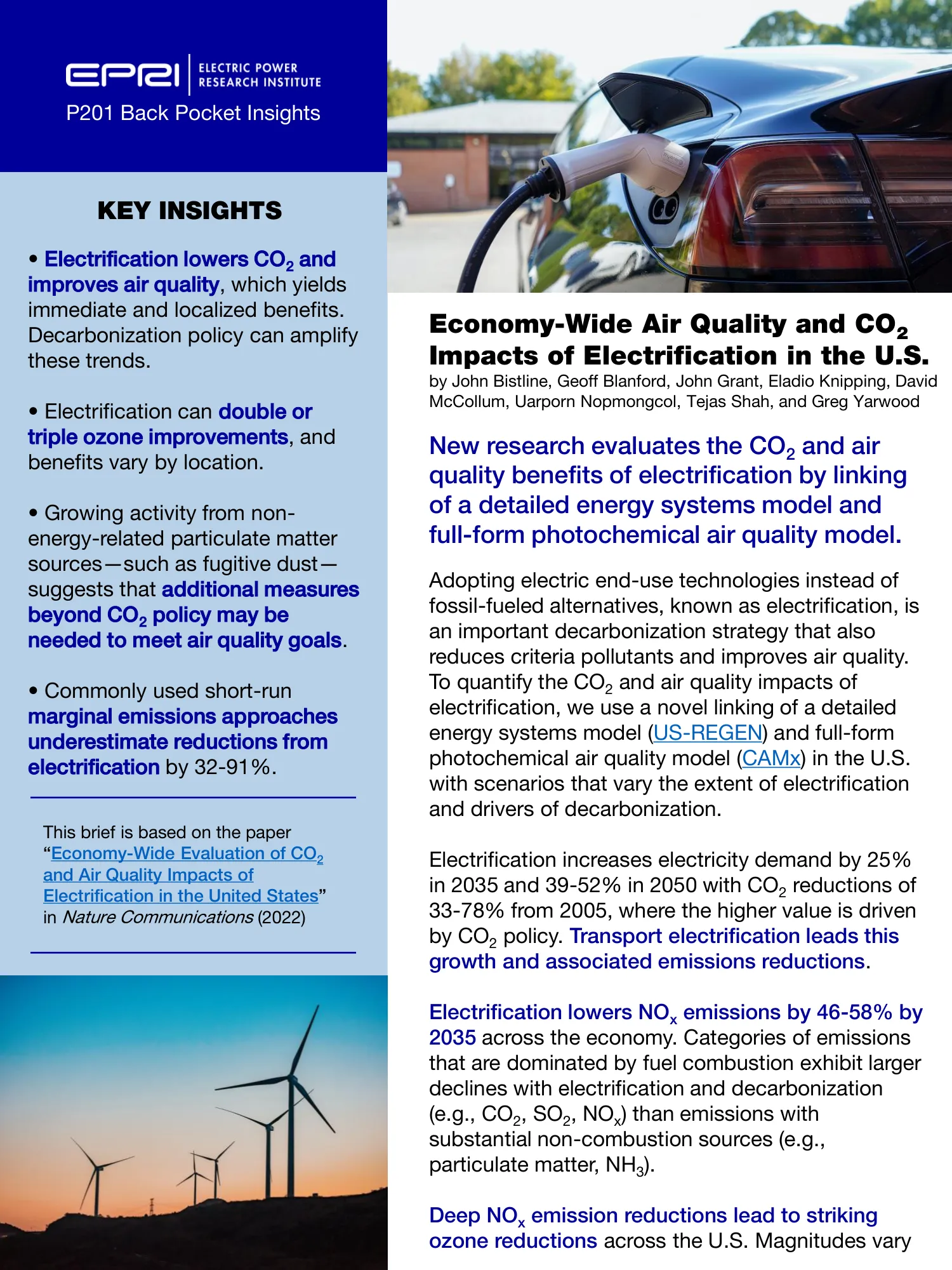
Economy-wide evaluation of CO2 and air quality impacts of electrification in the United States
John Bistline, Geoffrey J. Blanford, Grant, J. et al. Nat Commun 13, 6693 (2022).
- Article
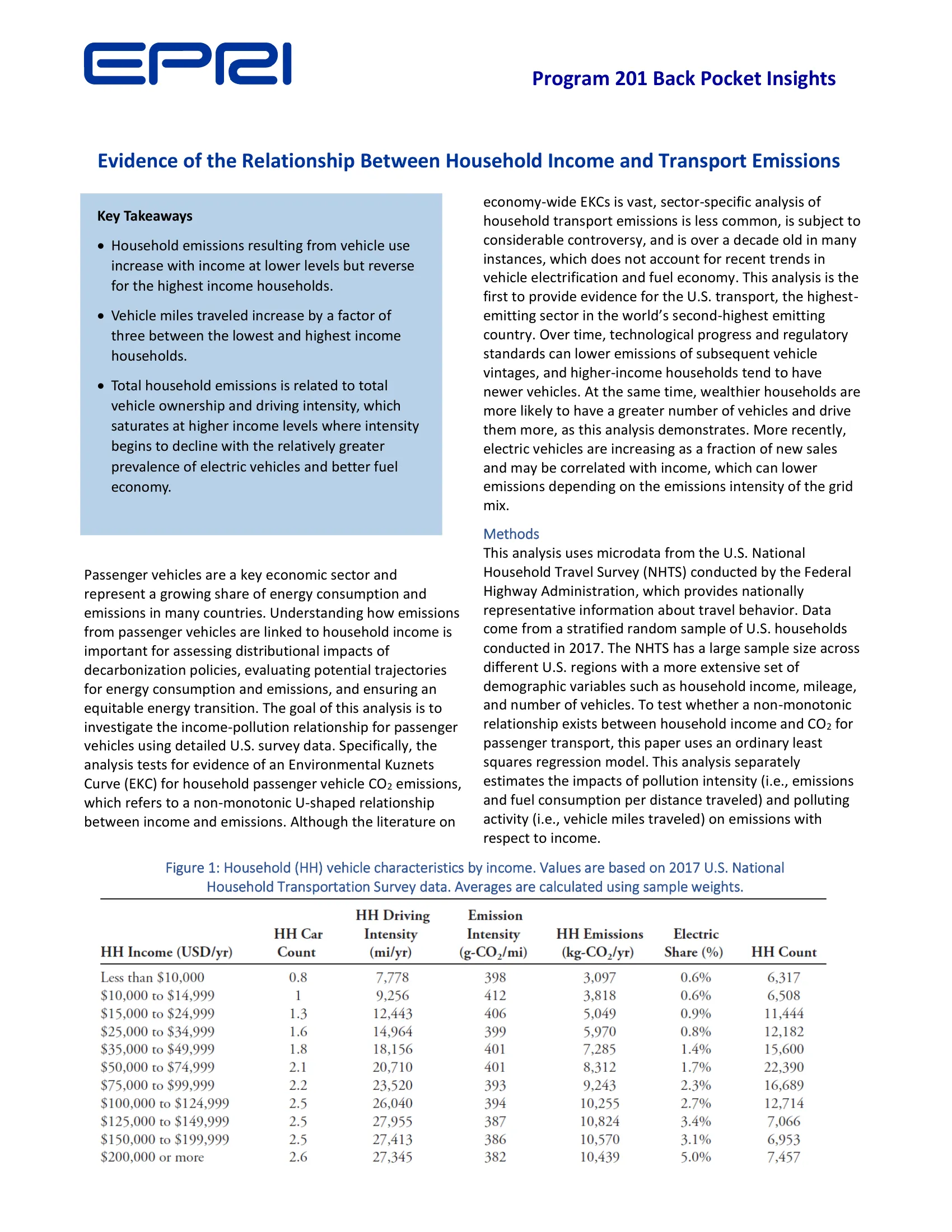
Household Environmental Kuznets Curves: Evidence from Passenger Transport Emissions
John Bistline Economics of Energy and Environmental Policy, vol. 12, no. 2, DOI: 10.5547/2160-5890.12.2.jbis.
EPRI Reports
Found 2 of 2
| Details | Title | Authors | Date | Type |
|---|---|---|---|---|
Win-Win Watts: When Can Data Centers, Efficient Electrification, and New Loads Lower Electricity Prices? | WHITE PAPER | |||
Can new electricity demand from data centers, electrification, and other sources actually lower average retail electricity prices? Despite widespread concerns, the answer is sometimes yes. This paper synthesizes economic theory, recent empirical and modeling evidence, and emerging tariff designs to clarify the conditions under which load growth can support affordability for existing customers while enabling investments in clean, reliable infrastructure. Available online: https://winwin.epri.com/ | ||||
Understanding Distributional Impacts of Decarbonization: Modeling Effects of Household Income on Transport Electrification | TECHNICAL UPDATE | |||
Decarbonization and supporting policies can have important implications for household expenditures on energy services with distributional impacts across different customers. Recent policies and incentives have included carveouts and other considerations of distributional impacts, environmental justice, and equity. This analysis investigates one dimension of equitable decarbonization for the transport sector—namely, how household vehicle purchasing decisions can vary across income classes. Using detailed survey data and EPRI’s U.S. Economy, Greenhouse Gas, and Energy (US-REGEN) model, which has been modified to include income classes, this analysis illustrates the effects of income on vehicle electrification and associated implications for costs and energy burdens. Electric vehicle adoption increases for higher-income households due to characteristics such as their higher driving intensities and lower effective discount rates. However, these income effects are small relative to other considerations, as electric vehicle shares are high across all household incomes (60–80% of new sales are electric by 2050). | ||||
1-2 of 2
Back Pocket Insights
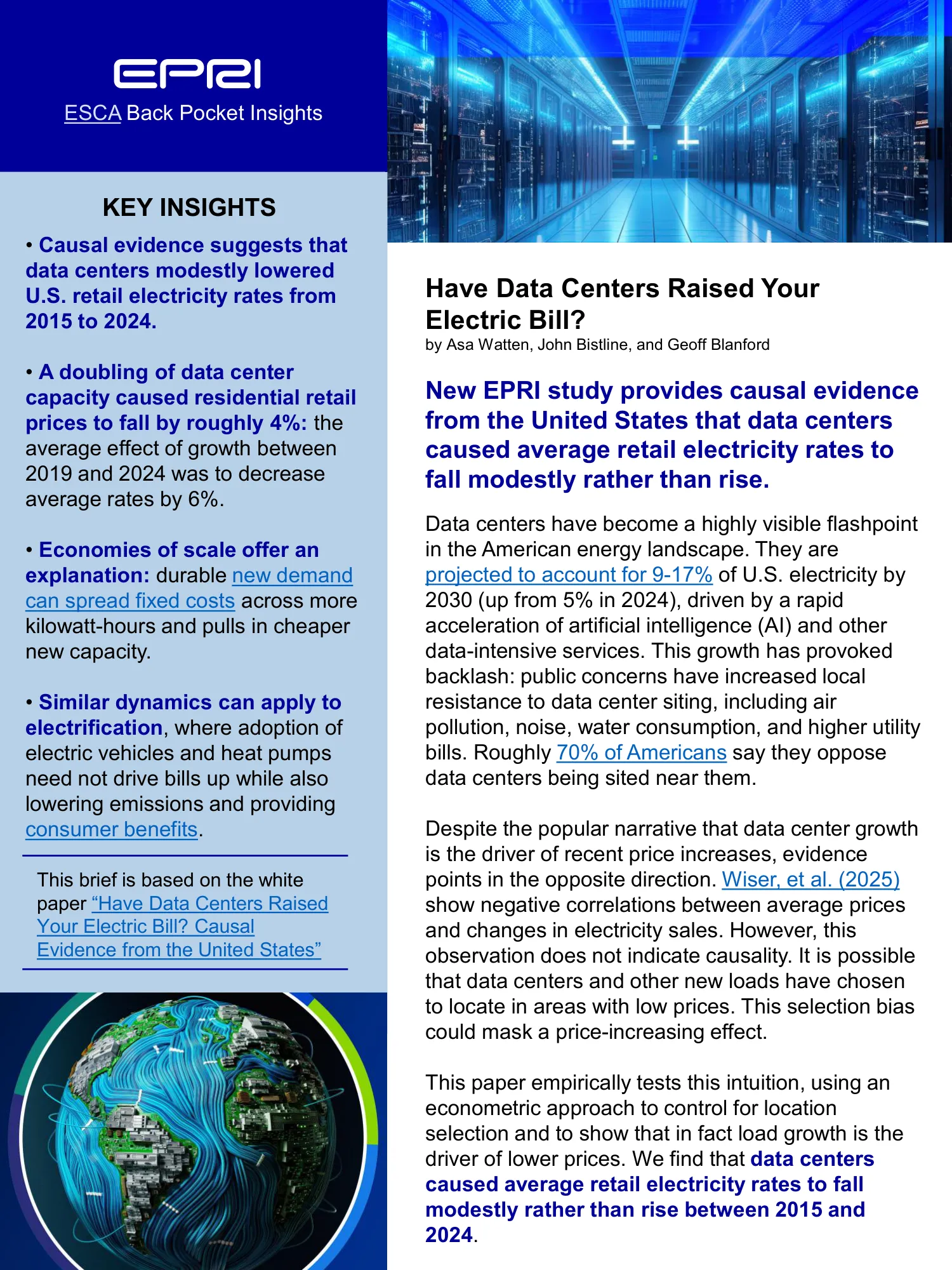
Have Data Centers Raised Your Electric Bill?
June 2026
Evidence of the Relationship Between Household Income and Transport Emissions
August 2023
Electrification and Air Quality
November 2022