Technology Economics produces objective cost and performance assessments for existing and emerging generation and storage technologies. These assessments cover technology roadmaps and cost trajectories, deployment drivers and constraints, and the system value of technology options, and provide the data planners need to compare resources on a consistent basis.
Publications and Presentations
Found 5 of 5
- 2026 Article
- 2021 Report
The Current State of Renewable Energy for Electricity
Cole, W, Mai, T, John Bistline, David Young Published in EM Magazine, a copyrighted publication of the Air & Waste Management Association, May 2021.
- 2021 Report
The Outlook for Wind and Solar Deployment: Drivers and Constraints
David Young, John Bistline, Cole, W, Mai, T Published in EM Magazine, a copyrighted publication of the Air & Waste Management Association, May 2021.
- 2020 Article
Value of Technology in the U.S. Electric Power Sector
John Bistline, Geoffrey J. Blanford Energy Economics
EPRI Reports
Found 9 of 9
| Details | Title | Authors | Date | Type |
|---|---|---|---|---|
Program on Technology Innovation: A Review of Power Procurement Mechanisms for Electric Companies and Corporate Buyers-Core Concepts, Contract Structures, and Trends | WHITE PAPER | |||
Electric companies and corporate buyers are navigating an increasingly complex energy landscape by using a diverse set of mechanisms to meet operational needs and other corporate goals. This report provides a foundational reference on how electricity is sourced, reviewing a broad range of power procurement pathways—including power purchase agreements (PPAs), regulated bilateral contracts, retail supply agreements, utility clean energy tariffs, self-generation, and wholesale market purchases. The report outlines key contract structures, market dynamics, and procurement considerations—including how different approaches may affect exposure to commercial and operational risks—while also examining trends in selected geographies outside the U.S. related to PPAs and wholesale markets. By clarifying the roles and trade-offs of these approaches, the report supports more informed decision-making and can help inform future work on topics such as 24/7 carbon-free energy, hydrogen-linked PPAs, and co-located generation and load. | ||||
Program on Technology Innovation: Charting the Course-Practical Considerations and Project Delivery Timelines for Energy Technologies | PRESENTATION | |||
A successful energy transition depends on the ability of electric companies to align resource planning, technology selection, engineering, project delivery, and ultimately, operations. While commercial viability and company and system needs inform investment decisions, planners and engineers must also navigate regulatory frameworks, supply chain challenges, and execution risks that shape how and when technologies move from concept to operation. This report provides an overview of the project delivery process for power generation and energy storage systems and selected enabling infrastructure (e.g., electric transmission). It identifies critical path elements and presents notional lead times for more than 20 technologies to support more informed planning and integrated technology deployment—both essential for meeting corporate objectives while supporting customer needs and broader societal goals in an evolving energy system. | ||||
Program on Technology Innovation: Generation Technology Options - 2024 | TECHNICAL UPDATE | |||
This report provides an executive-level overview of present (2023) and longer term (2035) cost and performance estimates for electricity generation and hydrogen fuel production technologies. The information in this report is based on recent EPRI research results, drawing from detailed studies performed throughout EPRI’s research portfolio to provide cost and performance estimates and brief descriptions for fossil fuel, nuclear, renewable, hydrogen, and storage technologies. The purpose of this document is to provide a public domain reference for industry executives, policymakers, and other stakeholders. Cost and performance estimates are for representative U.S.-based generating units and are presented in constant third-quarter (Q3) 2023 dollars. | ||||
Program on Technology Innovation: IRA Supply Chain and Workforce Analysis to Inform Technology Cost Assessments | TECHNICAL UPDATE | |||
The Inflation Reduction Act offers potentially beneficial tax credits for deploying new generation and storage assets, but some tax credit bonuses require compliance with certain criteria that may entail additional costs. Understanding the expected net benefit of the credits as well as some aspects of the market for apprenticeship labor and domestic content will help resource planners develop better cost assumptions for their planning efforts. This report begins with a brief overview of the Inflation Reduction Act of 2022 and an analysis of some of the key requirements for tax credit bonuses: the market for apprenticeship labor and domestic content in the United States. It then presents the findings of a cost study on compliance with the IRA’s labor and domestic content bonus requirements. The results indicate that compliance with the labor bonus requirements (prevailing wages and apprenticeships) may result in significant savings across technologies and credit types, whereas compliance with the domestic content bonus requirements (domestically sourced iron, steel, and manufactured products) may cost nearly as much or more than the value of the bonus. | ||||
Nuclear Energy in Long-Term System Models: A Multi-Model Perspective | TECHNICAL UPDATE | |||
Long-term energy system models—including electric sector capacity expansion models—are widely used tools for informing planning, technology assessment, and policy analysis. Recent decarbonization goals and rapid technological change have increased the need to appropriately represent economic characteristics and technical details of energy system resources, including variable renewable energy, energy storage technologies, carbon-capture-equipped capacity, and nuclear energy. Nuclear power represents about 20% of electricity generation and 50% of carbon-free electricity in the United States as of 2021. However, there are many perspectives on the role of existing and new nuclear in the future U.S. energy system, which is reflected in the broad range of potential contributions reported in the literature. This project aims to understand how issues central to nuclear energy are represented in long-term energy models. Building on earlier collaborations that focused on variable renewable energy and energy storage, this project convenes four modeling teams that use national-scale long-term energy system models from the Electric Power Research Institute, the National Renewable Energy Laboratory, the U.S. Energy Information Administration, and the U.S. Environmental Protection Agency to share methods and data, update models, run coordinated scenarios, and identify research needs. Improving tools can provide more insightful analyses and ensure that methods are more transparent. Guided by inter-model comparisons and intra-model scenario analyses, we investigate how model structures and input assumptions impact projections, refine model representations of nuclear energy, and communicate findings to the research community and consumers of modeled scenario results. A greater understanding of model structures, assumptions, parameters, and limitations can improve model capabilities to effectively represent interactions under a variety of market and technology assumptions. This report synthesizes our collective modeling experience, reviews the literature, and highlights research gaps—which results in recommendations on approaches for representing nuclear energy in long-term energy system models. Such comparisons can identify robust findings and critical assumptions impacting model projections. Nuclear energy’s role in forward-looking scenarios varies due to differences in scenario assumptions, model structure, and regional characteristics. The scenario design assumptions that have the greatest influence on nuclear deployment are policies and technological cost. Details about a policy’s stringency, timing, and technology eligibility influence decarbonization outcomes and nuclear deployment. Higher shares of nuclear generation occur in scenarios and regions with favorable:
Nuclear power can complement extensive additions of wind, solar, energy storage, and other resources by providing firm, zero-emissions electricity. The range of nuclear deployment in forward-looking scenarios highlights uncertainty moving forward, but it also stresses the importance of significant nuclear technology advancement and electric sector policies. Overall, these findings point to the important roles that underlying model structure and input assumptions play in projections for nuclear energy in mitigating climate change and lowering multiple air pollutant emissions. The four participating models have undertaken a variety of nuclear-specific modifications and broader model updates over the course of this project, which have altered model outcomes and improved insights. Model complexity can strongly impact projected electric sector investments and costs, and many considerations (e.g., parameterization of solar, wind, and storage technologies and temporal resolution) have more significant impacts with deeper decarbonization. Levelized-cost metrics are incomplete for evaluating the relative competitiveness of system resources, which requires detailed energy modeling to assess. The report also identifies several model development priorities and data needs related to nuclear and broader energy systems, including representing hybrid systems that support electric and non-electric applications, capturing integration across systems, linking modeling tools of different resolutions, and several others. | ||||
Program on Technology Innovation: Endogenous Learning for Projecting Future Capital Costs – Evaluation and Implications for Electric Power Generation Technologies | TECHNICAL REPORT | |||
As the electric power sector continues to transition in terms of the mix of power generation technologies supplying electricity, it is important to understand both the observed costs of those technologies and how they change over time. Having accurate technology cost information allows electric company planners and modelers to more effectively analyze potential future scenarios, which in turn impact investment decisions and ultimately how a company plans to meet their goals of delivering electricity to customers while achieving long term sustainability goals. This research demonstrates how endogenous learning models, when utilized and interpreted in consideration of key external factors (i.e., not directly related to innovation), can provide various stakeholders better insights to inform strategic decision making related to costs. Utilizing ranges of learning rates rather than a single learning rate may be more informative. The evaluation of literature-recommended learning rates highlighted that a 5%-10%-15% learning rate range is informative for better understanding potential future costs for natural gas combustion turbines, 1%-5%-9% for natural gas combined cycle projects, 18%-20%-22% for solar PV projects, and 10%-12%-14% for onshore wind projects. Market dynamics; evolving technology characteristics; research, development and demonstration (RD&D), input costs; project financing; regulatory requirements; government intervention; and sustainability ambitions are highlighted as external factors that have and may continue to influence cost and price developments, and/or how changes in production costs translate into changes in market prices of select power generation technologies. | ||||
Solar Plus Storage Cost Assessment and Design Considerations: Executive Summary | TECHNICAL UPDATE | |||
The deployment of paired solar PV and lithium ion battery storage systems is growing rapidly in the U.S. This is an executive summary of a study that evaluated the market applications and relative costs for paired solar plus storage systems, encompassing the multiple considerations a project designer needs to address in sizing such systems and configuring them to provide the intended grid services. The study emphasized the importance of understanding the full lifecycle cost of paired solar plus storage projects, and provides estimates for turnkey installed costs, maintenance costs, and decommissioning costs. Focus was placed on comparing the relative costs and operating characteristics of AC-coupled systems versus DC-coupled systems. Finally, the study examined the importance of understanding not just costs, but also performance and value of solar plus storage systems in comparing their relative competitiveness with incumbent technologies. Results of this analysis support the continued evaluation and potential deployment of paired solar plus energy storage as a grid asset. | ||||
The Economics of Nuclear Plant Modernization in U.S. Markets | TECHNICAL UPDATE | |||
Announcements of nuclear power plant retirements throughout the world have increased amid sustained low gas prices, market pressure from renewables, slow demand growth, and uncertainty about future policies. Although market and policy changes can have significant impacts, nuclear power plant owners and operators may decide to undertake modernization efforts to lower costs of plant operations and thereby improve their economic competitiveness in a changing landscape. This white paper describes a framework for assessing the economic value of modernizing the existing nuclear fleet in the United States and demonstrates how this value depends on future market, policy, and plant-specific conditions. Modernizing, in this context, means applied process improvements (for example, risk-informed decision making) and technologies (for example, digital monitoring and automation) to reduce plant operating costs. The goal of this analysis is not to provide precise estimates but to propose a structure for assessing the value of nuclear modernization and to offer order-of-magnitude approximations. Asset owners and operators can further refine these estimates using proprietary data or additional plant-specific assumptions. Although this paper focuses on U.S. markets, the methods used are applicable in any energy market in the world. Given the data and assumptions used in this paper, initial estimates suggest that many nuclear plants can justify investments of more than $100 million to modernize and reduce fixed operations and maintenance (FOM) capital costs by 25%. The break-even value of modernization varies significantly by plant, though it is typically higher for larger multi-unit plants. Cost reductions from modernization and market conditions also impact break-even value estimates, and these values tend to be higher under more favorable market conditions for nuclear, such as carbon pricing and higher natural gas prices. Premature retirements are a significant investment risk and driver of break-even values, but modernization may delay some retirements, which increases the value of modernization efforts. | ||||
Energy Storage Technology and Cost Assessment: Executive Summary | TECHNICAL UPDATE | |||
Rapid change is underway in the energy storage sector. Prices for energy storage systems remain on a downward trajectory. The deployment of energy storage systems (ESSs) -- measured by capacity or energy -- continue to grow in the U.S., with a widening array of stationary power applications being successfully targeted. This is an executive summary of a study that evaluates the current state of technology, market applications, and costs for the stationary energy storage sector. The study emphasizes the importance of understanding the full lifecycle cost of an energy storage project, and provides estimates for turnkey installed costs, maintenance costs, and battery decommissioning costs. This executive summary also provides a view of how costs will evolve in the future. Focus is placed on lithium ion and flow battery technologies; the former being the current market leader, the latter in the early stages of market adoption. Results of this analysis support the continued evaluation and potential deployment of energy storage as a grid asset. | ||||
1-9 of 9
Back Pocket Insights
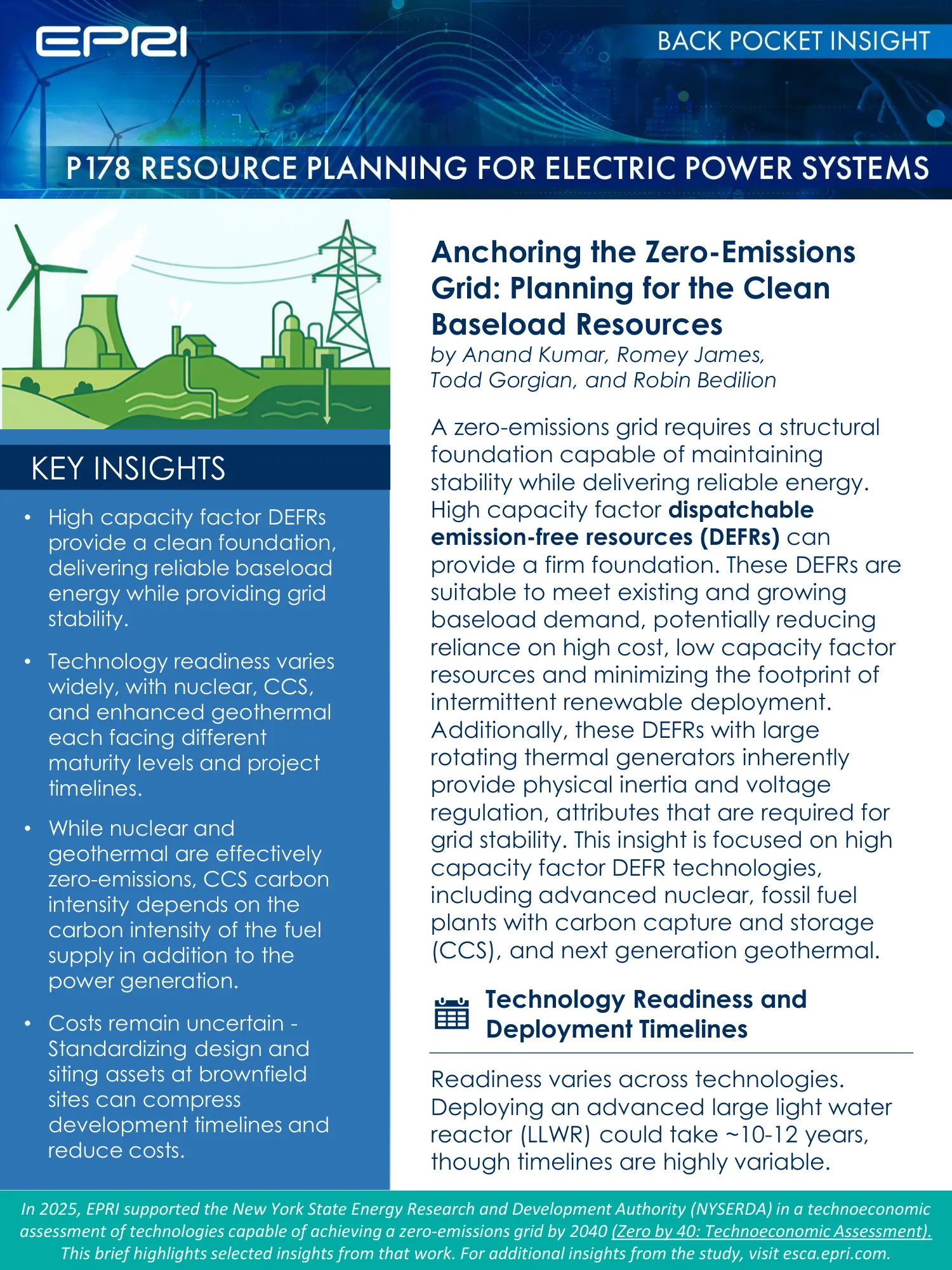
Anchoring the Zero-Emissions Grid - Planning for the Clean Baseload Resources
February 2026
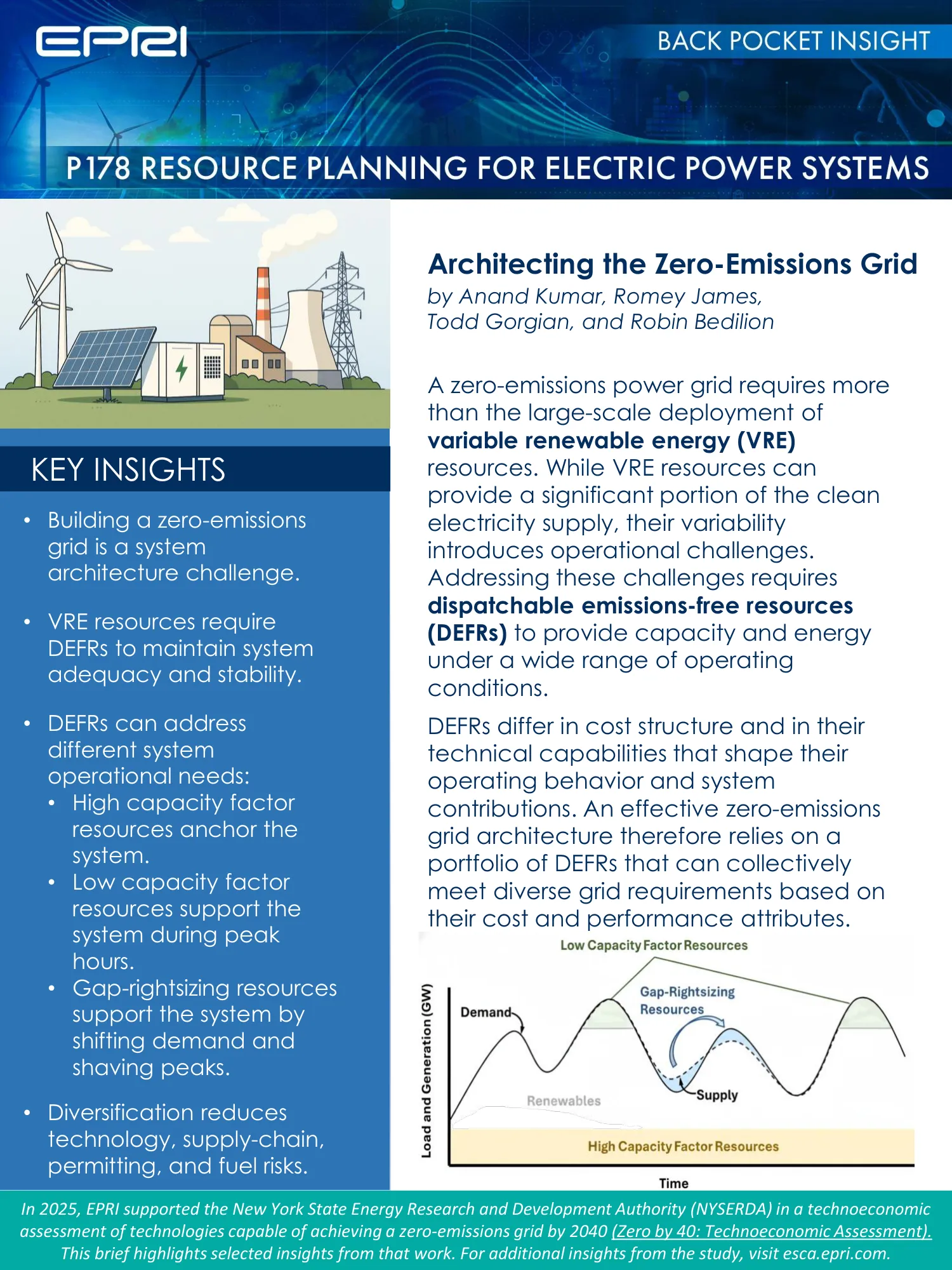
Architecting the Zero-Emissions Grid
February 2026
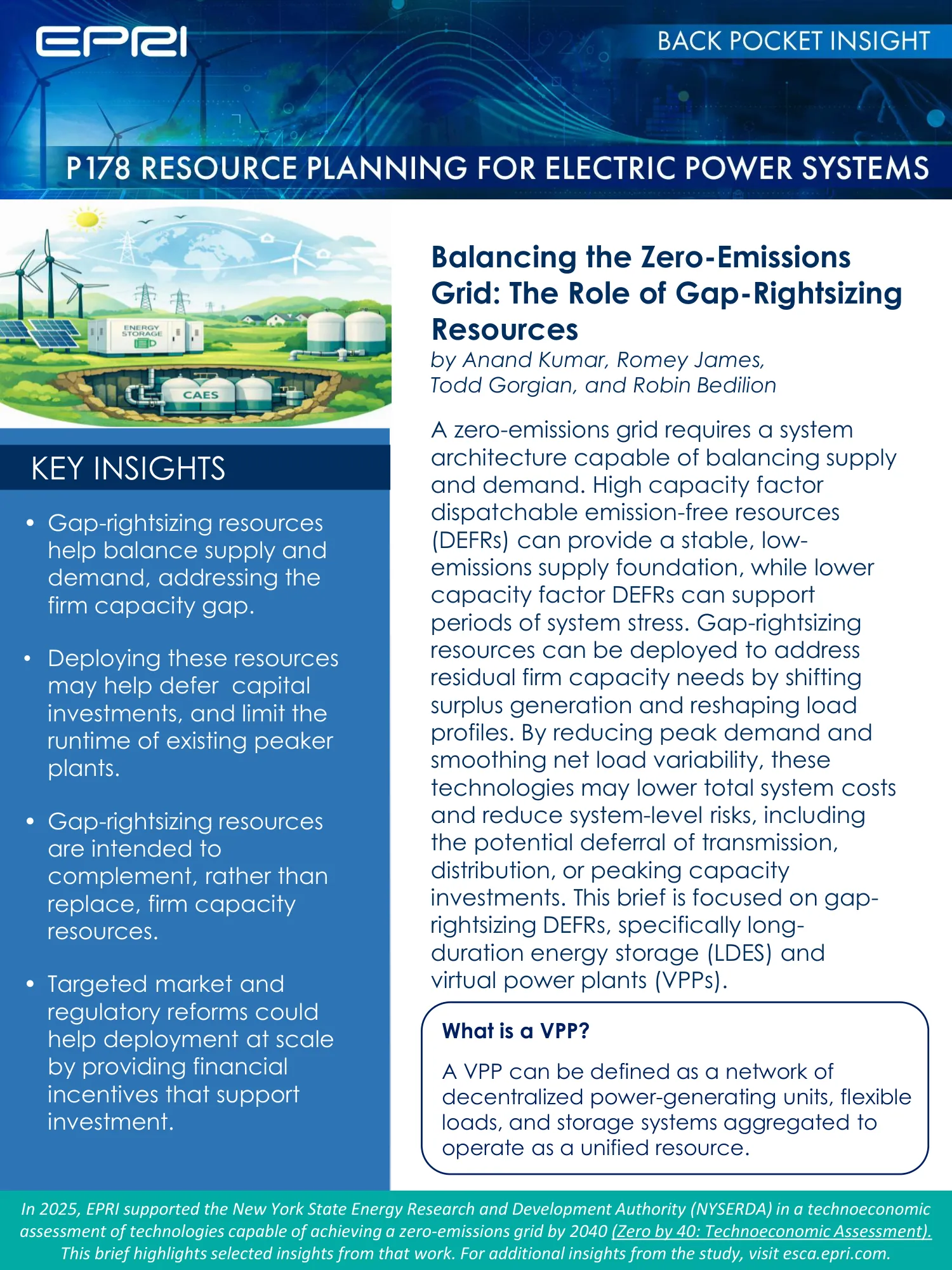
Balancing the Zero-Emissions Grid - The Role of Gap-Rightsizing Resources
February 2026
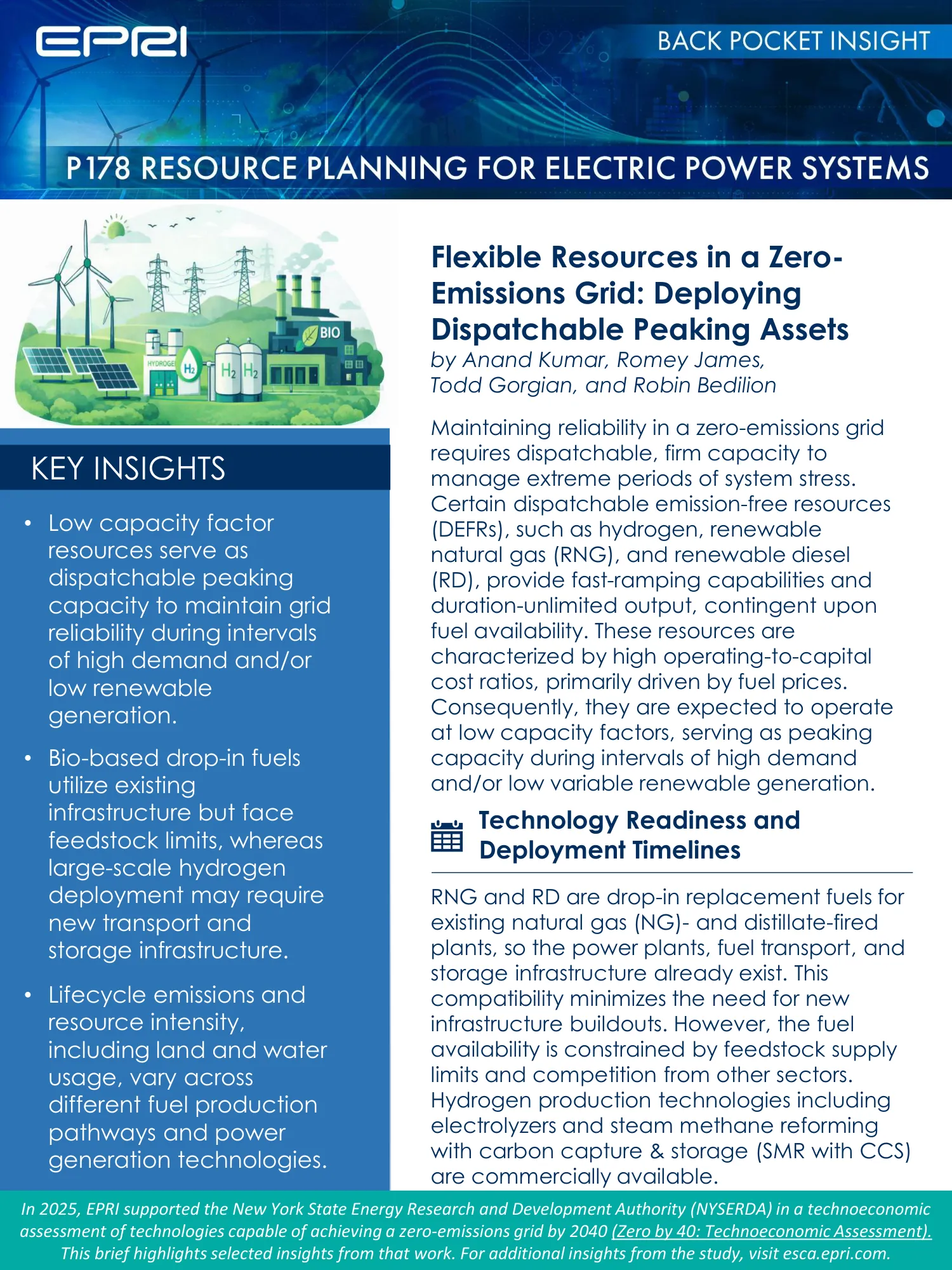
Flexible Resources in a Zero-Emissions Grid - Deploying Dispatchable Peaking Assets
February 2026
From Architecture to Action - Near-Term Priorities for Scaling Dispatchable Clean Resources
February 2026
Why are site-specific estimates often higher than generic cost estimates?
December 2025
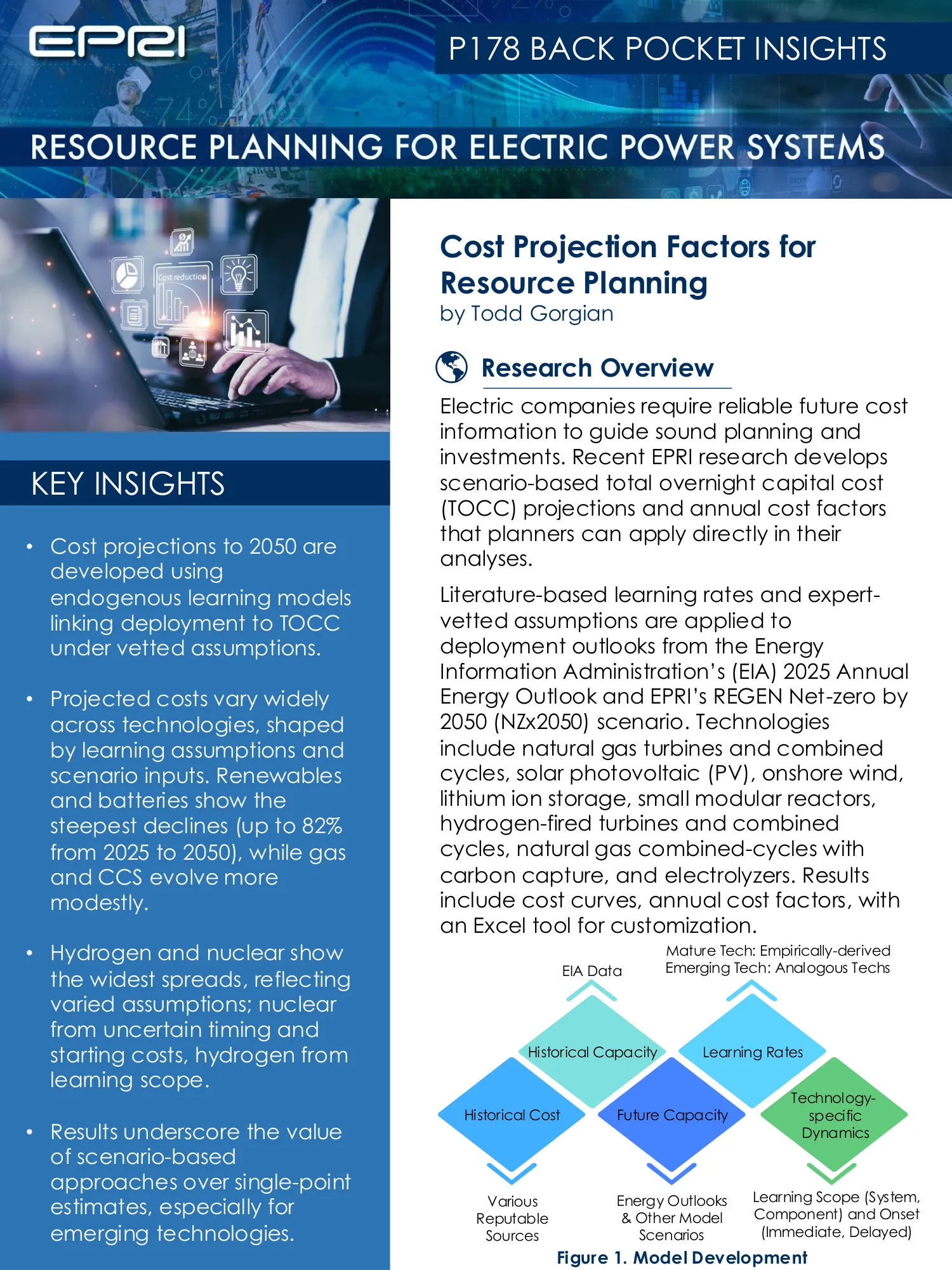
Cost Projection Factors for Resource Planning Insight
September 2025
Delivering the Energy Transition: Project Timelines & Considerations
September 2025
An Insider's Guide to the Calculation and Use of LCOEs
January 2020