ESCA Investigates Impacts to the Energy System from Climate and Current Events
We are pleased to share this edition of the Energy Systems and Climate Analysis (ESCA) newsletter highlighting our team's recent research. Findings here address:
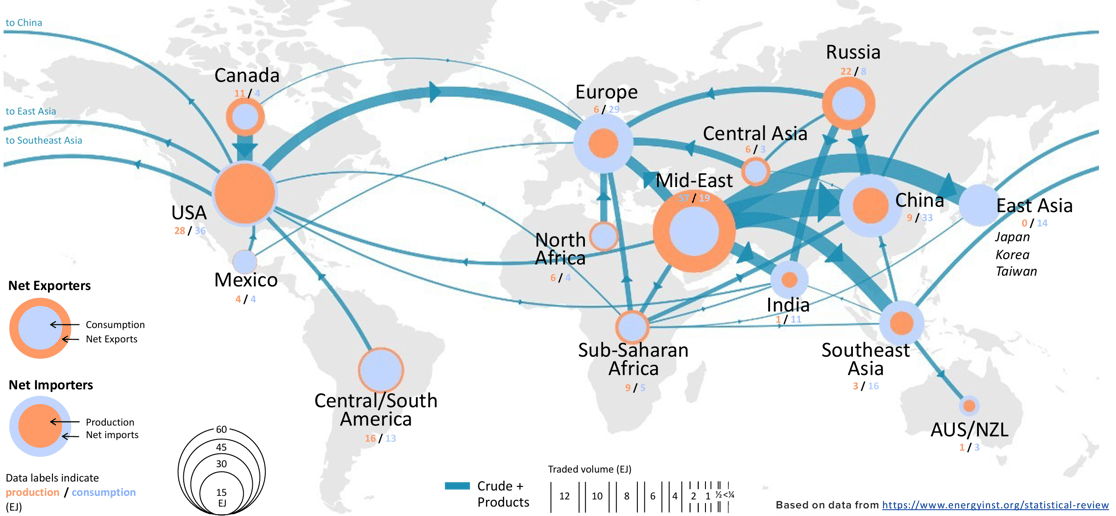
Inter-Regional Petroleum Net Trade Flows in 2024. Middle East oil exports through the Strait of Hormuz represent 20% of global demand.
EPRI modeling using the MERGE model has explored scenarios for future global and regional supply, demand, and trade of both conventional and emerging fuels. Model data and analysis were leveraged in a recent study to better understand impacts of the conflict in the Persian Gulf region. Analysis highlights the vulnerability of global trade flows of energy and related products to these types of geographic and geopolitical factors. The current situation emphasizes how inter-connected global regions are and the importance of integrated supply chain analysis for strategic energy planning.
Research priorities for robust climate assessments in the U.S.
Three ESCA researchers (John Bistline (now at Watershed), Laura Fischer, Chris DeLyser Roney) contributed to this paper convened by the American Geophysical Union (AGU) and American Meteorological Society (AMS). The paper identifies topics ready for assessment and/or where there is need for additional research and offers guidance and direction to the research community to ensure that the corpus of research remains robust for future assessments. ESCA contributors produced a short summary highlighting key takeaways from the full report. Access both below.
New NEA-EPRI analysis finds electricity systems are becoming more diverse – and more costly
ESCA researchers partnered with the Nuclear Energy Agency (NEA) to produce the latest edition of The Costs of Generating Electricity 2025, which provides comprehensive and internationally comparable data on the levelized costs of generating electricity across 21 NEA member countries and 23 technologies.
Technical Considerations for Global Warming Level Frameworks for Climate Assessment and Use in Energy System Planning
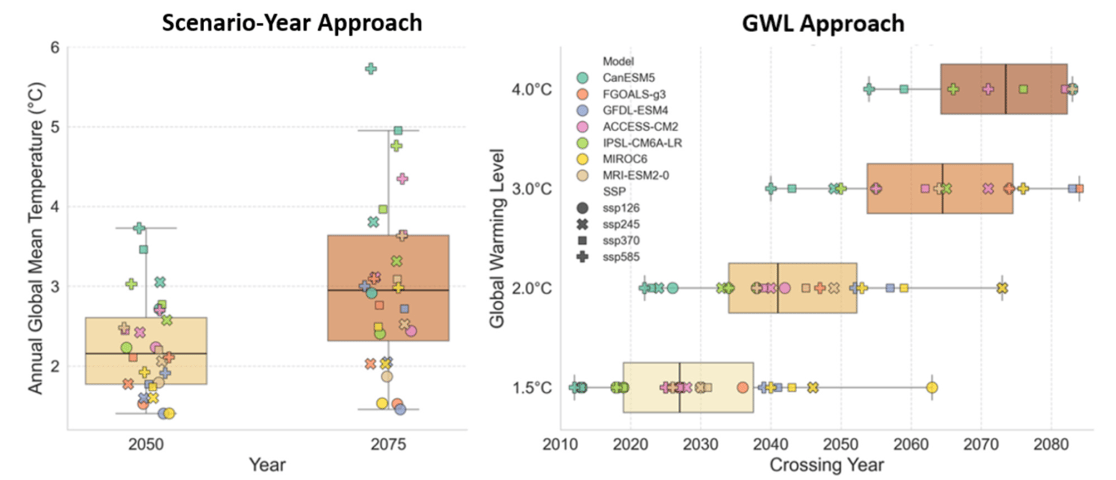
Uncertainty dimensions of the two frameworks. (Left) The scenario-year approach produces uncertain warming outcomes for specific timeframes (2050 and 2075). (Right) The GWL approach anchors projections to fixed temperature thresholds, resulting in uncertain crossing years. Both panels display data from eight CMIP6 models (differentiated by color) across four Shared Socioeconomic Pathways (differentiated by marker shape).
This technical brief evaluates Global Warming Level (GWL) frameworks as an alternative to traditional scenario-year approaches for assessing climate hazards and informing energy system planning and identifies how emerging advances in climate modeling and artificial intelligence could further enhance these integrated assessments. Conventional climate assessments rely on projections tied to specific emissions pathways and future time horizons whereas the GWL framework conditions climate outcomes on predefined global average temperature thresholds, effectively isolating the physical magnitude of global warming from model-driven regional variability. For utility planning, spanning infrastructure design, risk assessment, and regulatory compliance, these two frameworks are ultimately complementary. Rather than choosing one over the other, energy sector decision-makers can utilize hybrid approaches that integrate the temporal strengths of scenario-year modeling with the physical risk thresholds of the GWL framework.
Caroline Draxl and Delavane Diaz are guest editing a special issue “Extreme Weather and Climate Impacts on Energy System Resilience” of the journal Energies. This Special Issue aims to collect, present, and share recent research advances that tackle how changing weather and climate events affect the reliable operation and infrastructure of the energy system, as well as methods for resilience planning and adaptation prioritization.
Submissions are invited through March, 2027 with advance coordination appreciated.
More information about the Special Issue can be found at the link above or by contacting Caroline Draxl or Delavane Diaz.
A Multi-Model Assessment of the Air Quality and Health Impacts of US Energy Decarbonization
EPRI researchers applied US-REGEN in their contribution to a recent multi-model study assessing air quality and health impacts of U.S. energy decarbonization. Findings demonstrate that a net-zero transition can yield robust nationwide reductions in ambient PM2.5 concentrations and associated mortality. However, sensitivity analyses suggest that emissions from growing non-energy activities, like wildfires, could offset energy-sector health benefits. Read the full article to learn more.
Exploring Practical Challenges to Implementing Proposed Revisions to Scope 2 Market-based Accounting and Reporting
Recent ESCA research examines practical challenges companies may face when procuring low-carbon electricity resources under new spatiotemporal matching requirements proposed by the Greenhouse Gas Protocol (GHGP) in its 2025 Scope 2 Public Consultation. The proposed revisions would require companies reporting greenhouse gas (GHG) emissions from purchased electricity using the scope 2 market-based method to move from annual matching of purchased electricity and end-use consumption to hourly matching, while also requiring qualifying electricity to be generated in the same geographic location where it is consumed. This report provides insights into how these proposed scope 2 requirements may affect corporate voluntary procurement of renewable electricity and other low- and non-emitting resources, the future capital that may be deployed to acquire hourly matched and geographically constrained energy resources, and key challenges companies and other stakeholders may encounter when procuring qualifying electricity.
Over the past decade, energy attribute certificates (EACs) have evolved from their original purpose for utility compliance with Renewable Portfolio Standards (RPS) to broader applications. Today, EACs are used in a variety of voluntary and regulatory applications, including scope 2 market-based greenhouse gas (GHG) accounting, renewable electricity claims, clean fuel and hydrogen certification programs, and financial accounting. This white paper provides an overview of how EACs are used across these functions to track and verify electricity-related attributes, support emissions accounting and compliance objectives, and reduce the risk of double counting and over-allocation of environmental claims.