Assessment of newer global emissions pathways, impacts of state policy on U.S. energy system, and more
We are pleased to share this edition of the Energy Systems and Climate Analysis (ESCA) newsletter highlighting our team's recent research. Findings here address:
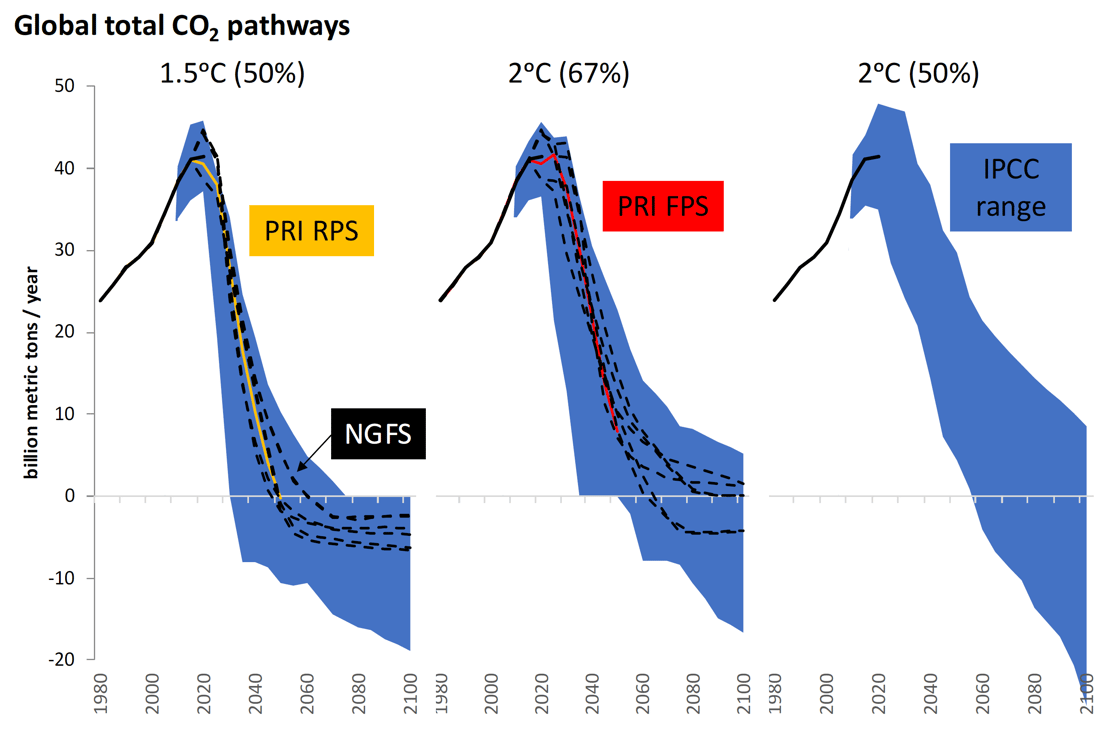
Assessment of newer global emissions scenarios for corporate climate transition risk and target setting applications
Global GHG emissions pathways are an important input in climate change dialogue, informing policy discussions on potential global climate management for achieving the temperature goals of United Nations Framework Convention on Climate Change’s (UNFCCC’s) Paris Agreement, as guides or benchmarks for corporate climate targets and assessments of carbon risk, and as key inputs to global climate change projections that inform physical climate risk assessment. It is essential to understand the global emissions pathways and how to appropriately interpret and apply them in corporate decisions. New EPRI analysis evaluates the latest vintage of global greenhouse gas (GHG) emissions pathways to facilitate proper interpretation, application, and informed dialogue and decisions related to corporate climate target setting and risk assessment.
Energy system implications of market drivers and state policy
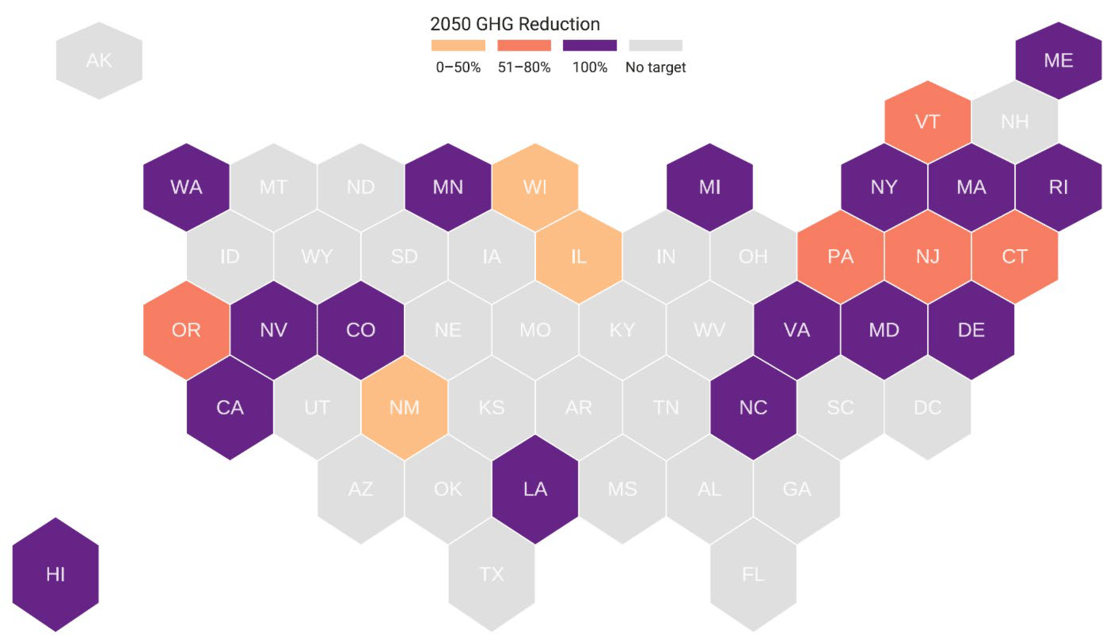
Market drivers (including data center load growth, shifting fuel prices, and evolving federal incentives) are reshaping energy system investments, while U.S. state clean energy and emissions policies are expanding. This analysis uses EPRI’s U.S. Regional Economy, Greenhouse Gas, and Energy Model (US-REGEN) energy systems model to evaluate how policy and market drivers could affect energy technology investments, fuel use, emissions, and costs through 2050. Model results suggest that state policies may accelerate the adoption of emerging fuels and technologies, with the scale and composition set by policy stringency and costs. Electric capacity additions and load growth exceed recent historical rates across most scenarios and regions. Key findings highlight planning needs across resources, sectors, fuels, and geographies to meet growing energy demand while achieving reliability, affordability, and energy and emissions goals.
Measuring Impact and Taking Credit for Electric Company Actions that Reduce GHG Emissions
Powering Intelligence 2026: Updated Scenarios of U.S. Data Center Electricity Use and Power Strategies
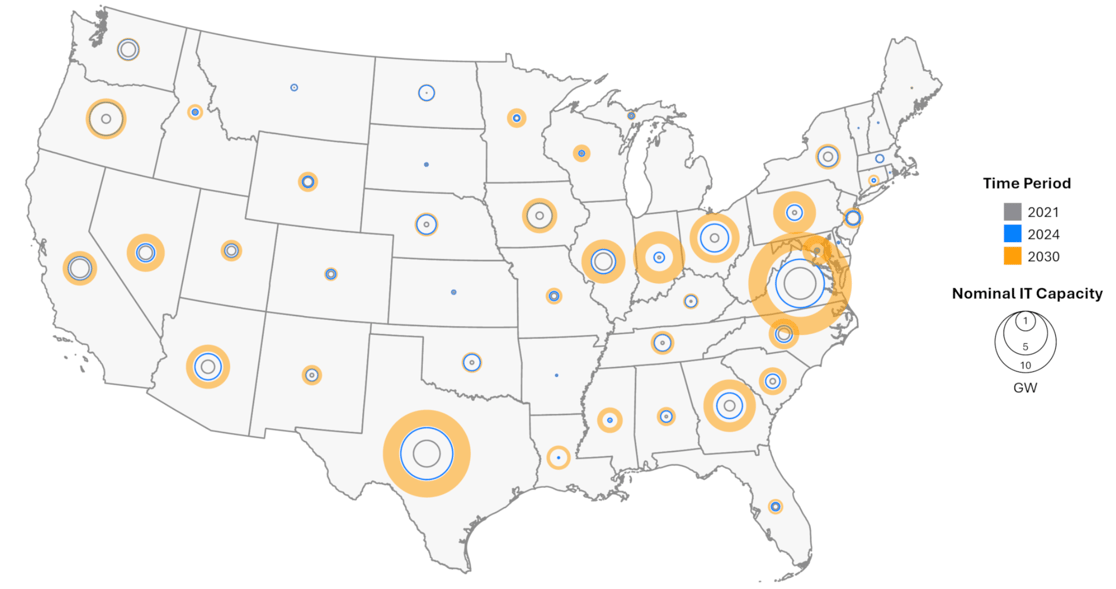
Data centers have become the fastest-growing source of U.S. electricity demand, and regional clusters of facilities are transforming local grid dynamics, testing utilities’ ability to keep pace and spurring technical and business innovation. A major uncertainty in projecting data center load growth is the broad emergence of AI technologies, highlighted by the rapid adoption of generative AI models since November 2022. Forecasting future data center (DC) load growth is essential for power system planning but remains difficult because public reporting is limited, many announced projects are speculative, and there is fundamental uncertainty about the adoption of generative AI and successor technologies. Several recent EPRI reports have discussed the key drivers of DC electricity demand and developed estimates of current and projected future data center load at the state level for the U.S. This report updates EPRI’s prior estimates, using new data on planned and announced projects rather than extrapolating historical trends. It also adds deeper modeling of key DC electricity metrics: nominal IT capacity, non-IT data center power use, capacity utilization, and annual and peak energy use.
Figure ES-1. Data center nominal IT capacity by state. Inner circles show capacity in 2021 (gray) and 2024 (blue). Outer band shows scenario range of projected capacity in 2030 (orange). Circle area is proportional to nominal IT capacity.Estimates include small- and large-scale data centers as well as cryptocurrency mining. Results highlight continued concentration in established markets (e.g., Virginia, Texas) alongside emerging growth in new states as developers diversify geographically. State-level estimates of nominal capacity and electricity use are provided in the Data Dashboard.
Unpacking NYSERDA "Zero by 40" techno-economic assessment
In 2025, ESCA supported the New York State Energy Research and Development Authority (NYSERDA) on the “Zero by 40” techno-economic assessment. The assessment examined potential dispatchable emissions-free resources capable of supplying clean, reliable power to the New York State grid, supporting the goal of achieving zero emissions by 2040. ESCA researchers recently released a series of 5 two-page briefs to digest the full report and make specific findings more accessible. Access the full report or view each brief below in their suggested order for optimized learning.
System effects of carbon-free electricity procurement on regional technology, costs, and emissions
A new article in The Electricity Journal highlights ESCA’s work evaluating system effects of procuring 24/7 carbon-free electricity. Voluntary carbon-free electricity (CFE) procurement has the potential to accelerate electric sector decarbonization, but procurement strategies vary widely, leading to uncertainty about emissions, investments, and costs. This study assesses the system-wide effects of voluntary CFE procurement on U.S. regional power systems using a detailed energy systems model across a range of program designs, eligible technologies, policy environments, and modeling assumptions. Results suggest that hourly matching—where clean electricity procurement aligns with hourly load—combined with new and local generation could maximize emissions reductions from CFE procurement.
Evolving Electricity Supply and Demand under a Net-Zero Economy Scenario: Insights from the EMF-37 Study
This paper explores the role of electricity in achieving economy-wide net-zero CO2 emissions by 2050 in the United States based on results from 17 models as part of the 37th Stanford Energy Modeling Forum (EMF-37). In the study’s Net-Zero scenario, the models use diverse pathways to achieve net-zero emissions by 2050, with gross energy-related residual emissions ranging from 17.2 to 66.6 % of 2020 levels. The electricity generation mix varies across models: some project almost complete reliance on renewables, while others see a substantial role for natural gas, often with carbon capture and storage. This paper synthesizes the rich diversity of modeling approaches and results, highlighting differing views on how key drivers of electricity demand and supply might evolve.