cutting-edge climate change and decarbonization research.
Research Highlights
Employing stochastic analysis in electric system planning
Managing risk demands that electricity planning approaches consider inherent uncertainties that may affect the value of an electric company’s high-dollar investments over decades. Recent research from P178 (Resource Planning for Electric Power Systems) explores how electric planners may apply stochastic techniques to address uncertainty when developing resource portfolios.
Stochastic resource planning analysis refers to the practice of varying inputs to quantitative models where the varied inputs are assigned probabilities reflective of their likelihood of occurring, and where the goal is to understand the risk of potential future outcomes. This consideration of probabilities is what makes stochastic methods different than other existing resource planning practices that consider uncertainty. Check out the following reports to learn more about using stochastic methods to manage risk as an electric system resource planner.
Carbon pricing and emissions accounting in wholesale power markets
ESCA's Adam Diamant collaborated with several researchers in EPRI’s Program 246 (Electricity Market Design and Operation) to develop a report describing how accounting for and valuing greenhouse gas emissions has been implemented in different wholesale power markets in the United States and internationally. Read the report to learn how these carbon markets and the related wholesale electricity markets have tried to address the technical challenges associated with implementing carbon pricing and explore challenges in accounting for GHG emissions in wholesale power markets. The team also prepared a short summary Quick Insight highlighting key takeaways.
Impacts of the IRA on energy system investments and emissions
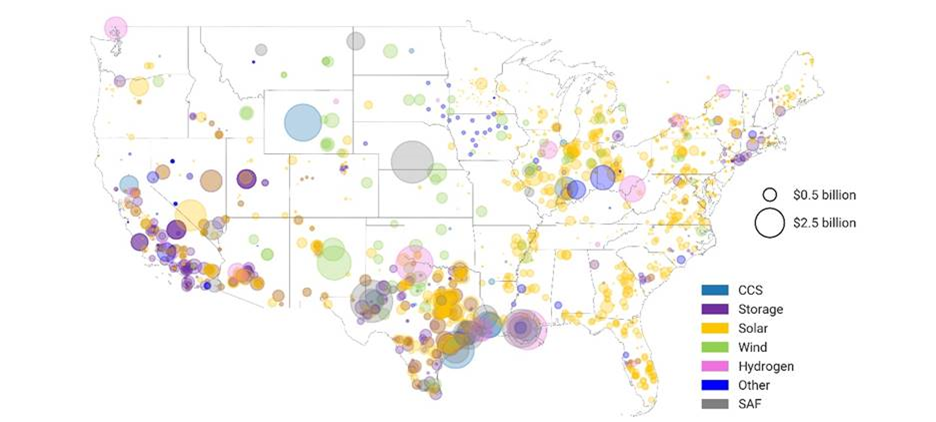
Figure 2:Geographical distribution of investment under IRA from 2022 Q3 through 2024 Q3. Energy and industry investment by technology. Data come from the Rhodium Group-MIT/CEEPR Clean Investment Monitor (2024 Q3) available at https://www.cleaninvestmentmonitor.org/. Bubble size is proportional to plant-level investment.
New analysis from ESCA's John Bistline and Aranya Venkatesh highlights potential issues in assessing the impacts of investment-based policies and brings together empirical and modeling estimates of impacts of the U.S. Inflation Reduction Act (IRA) as a case study. Read the white paper for analysis of record levels of investment after IRA's passage.
A recently completed ESCA supplemental project, the 24/7 Carbon Free Energy Buyer's Forum, brought together potential suppliers and commercial, industrial and government consumers of 24/7 CFE products to discuss challenges and solutions to more widely deploying 24/7 CFE resources. Building on this work, this report explores three key topics related to the potential deployment of CFE on a 24-hour, seven day per week basis (24/7 CFE): 1) A review of existing and advanced future carbon-free power generation technologies and their expected cost and performance; 2) Energy supply agreements and electric utility tariff designs that may facilitate deployment of 24/7 CFE; and 3) Data tracking and reporting associated with the purchase and use of 24/7 CFE products.
Representation of geothermal resources and technologies in US-REGEN
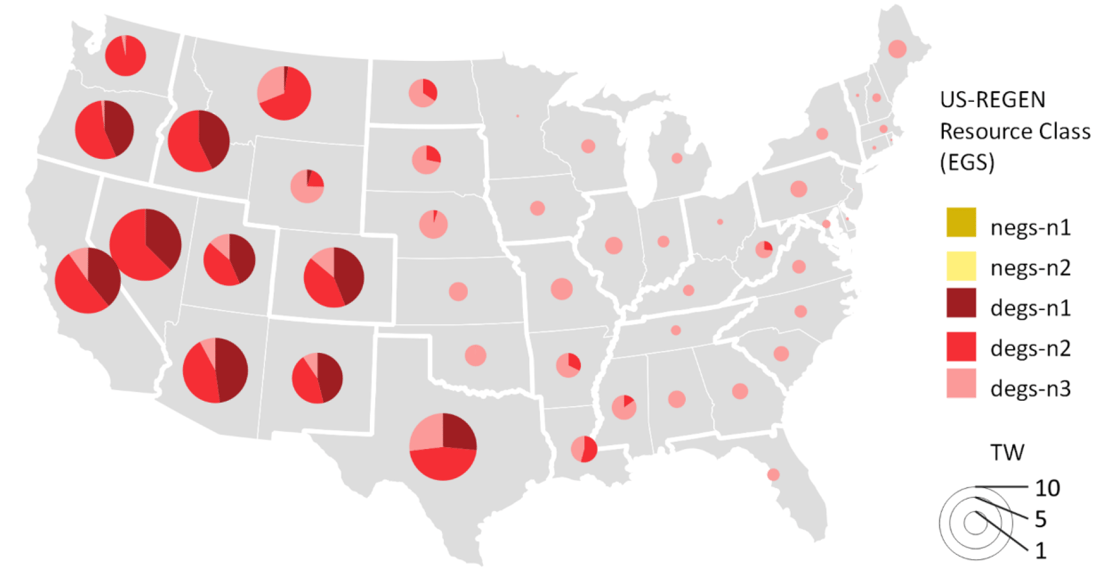
Geothermal energy is gaining attention as a reliable source of clean, firm power for the U.S. power sector, spurred by advancements in enhanced geothermal systems (EGS) and drilling techniques. To address its underrepresentation in capacity expansion models, EPRI and the National Renewable Energy Laboratory, with funding from the Department of Energy’s Geothermal Technologies Office collaborate in this project to enhance the representation of geothermal technologies and resources in EPRI’s US-REGEN model and to derive general guidelines for improving the representation in other capacity expansion models. Read the report to learn how the findings underscore the relevance of incorporating EGS into capacity expansion models and offer guidelines for better technology integration.
Figure 3: Near-field EGS (negs) and deep EGS (degs) resources limits by class and state in US-REGEN
Mapping heating and cooling loads to assess the potential of thermal energy networks
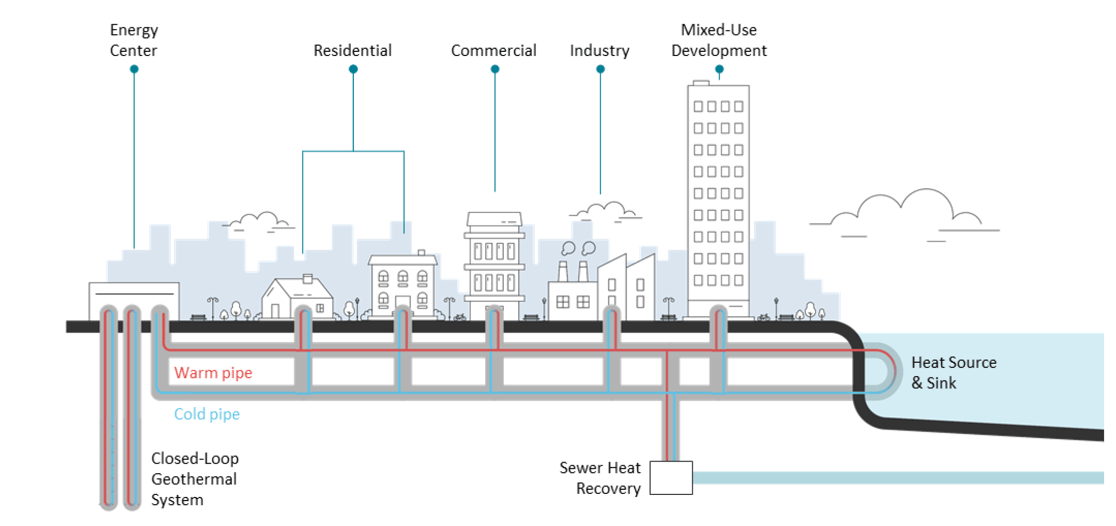
Figure 4. Two-pipe loop thermal energy network with multiple heat sources and heat sinks.
Thermal energy networks offer a neighborhood-scale decarbonization strategy, using shared infrastructure to efficiently transfer thermal energy among interconnected buildings and shifting the focus from individual building-level solutions. While pilot projects have demonstrated localized benefits, the broader impacts of scaling thermal energy networks in the U.S. have not been explored. In this report, ESCA researchers establish key criteria for assessing the feasibility of thermal energy networks and develop a geospatial methodology to map thermal energy sinks. The analysis presents a case study in Framingham, Massachusetts using scalable tools and publicly available geodata to characterize building stocks, calculate heating and cooling loads, and identify high-density load centers. Read the report to explore these findings and learn more about guidelines to expand the analysis and advance the assessment of the system-wide value of large-scale deployment of thermal energy networks.
Reconciling widely varying estimates of the global economic impacts from climate change
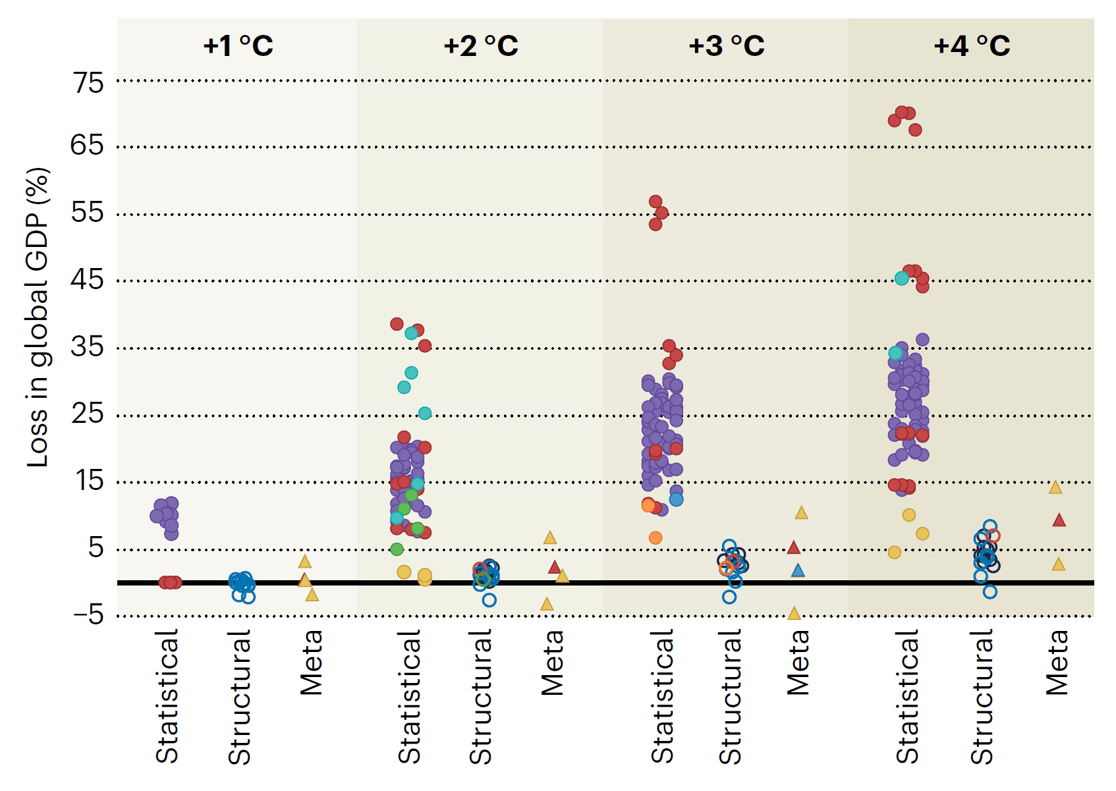
ESCA researcher Steve Rose co-authored a new article in Nature Climate Change that illustrates the huge variation in estimates of the global economic impacts of climate change and highlights differences in methods as a key factor, with statistical methods producing significantly higher estimates than structural modeling approaches. Read the article to learn more about why the authors argue that, to identify a robust range, it is essential to understand the mechanisms behind the differing estimates and to treat the different types of estimates as different lines of evidence. Only then, the authors argue, could these estimates meaningfully inform and guide decision-making.
Figure 5: Global aggregate economic impact estimates by global warming level and methodology type (annual % global GDP loss relative to GDP without additional climate change).
Program Manager Nidhi Santen joined USEA Power Sector Podcast to discuss how variable and customer-owned energy resources, rising demand, and new policy are driving innovations in utilities’ longstanding use of integrated resource planning, or IRP, to optimize affordable reliable electricity delivery.
Berkeley's Energy Institute at Haas released a blog post written by Meredith Fowlie that discusses a recent working paper from ESCA researchers John Bistline and Asa Watten titled, "Inframarginal Investments with Clean Energy Subsidies: Evidence from the Inflation Reduction Act."
Upcoming Events
EPRI’s 28th Energy and Climate Research Seminar
Designed to provide an opportunity for utilities, energy industry leaders, and policy decision-makers to hear directly from and engage with experts and scientists on frontier research issues and key policy drivers, our 28th annual seminar will be held in-person at the Washington Marriott Capitol Hill May 8-9 in Washington, DC. The agenda covers national and global energy and climate policy, near-term demand drivers and utility planning, permitting, climate impacts on the power sector, and company target-setting. See past seminar materials on our website.
Confirmed speakers include, among others, Dan Dudis (Senate Committee on Environment and Public Works), Dirk Forrister (President/CEO of the International Emissions Trading Association), Priya Donti (MIT), Sean James (Microsoft), and Rich Glick (former FERC Chairman). The event draws over 120 key stakeholders and experts from utilities, industry, government, academia and the NGO community, and is held under Chatham House rules.